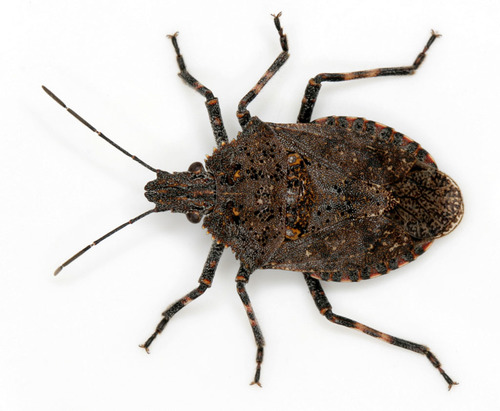
Four-humped Stink Bug
Brochymena quadripustulata
A true master of mimicry, the Four-humped Stink Bug hides in plain sight on the bark of your favorite trees. Identifying one is a badge of honor for any backyard naturalist.
Quick Identification
Size
12 to 17 mm (0.47 to 0.67 inches) in length; roughly 6-8 mm in width.
Colors
Mottled gray, brown, and charcoal black; cryptic bark-like pattern. Occasional orange or yellow speckling on the edges of the abdomen.
Key Features
- Four distinct tooth-like humps on the sides of the thorax
- Rough, heavily pitted body surface resembling tree bark
- Elongated, shield-shaped profile
- Alternating light and dark bands on the outer edge of the abdomen
When You’ll See Them
Behavior
The Four-humped Stink Bug is a master of camouflage, often referred to as a 'Rough Stink Bug' due to its textured exoskeleton. Unlike many of its cousins that prefer garden vegetables, this species is primarily arboreal, spending the majority of its life clinging to the bark of trees where it is nearly invisible to predators. It is a slow-moving insect that relies on its disguise rather than speed to survive.
While most stink bugs are strictly herbivores, the Four-humped Stink Bug is unique for its opportunistic feeding habits. It primarily uses its piercing-sucking mouthparts to drink sap from deciduous trees, but it has also been observed acting as a predator, occasionally feeding on soft-bodied larvae and caterpillars. They are generally solitary and do not form the massive, annoying indoor swarms associated with the invasive Brown Marmorated Stink Bug.
EverydayEarth exclusive
Camera Tips
To successfully capture a Four-humped Stink Bug on camera, you must focus on 'vertical' terrain. Instead of pointing your camera at a bird feeder or the ground, mount it directly onto the trunk of a mature deciduous tree—Black Walnut, Ash, or various fruit trees are ideal. Position the lens about 12 inches away from the bark. Because these bugs are so well-camouflaged, you will need high-resolution settings to distinguish them from the texture of the tree itself.
Use a side-lighting setup if possible. When the sun hits the tree from an angle, the shadows cast by the 'four humps' and the rough pits on the bug's back will make it pop against the flatter bark surface. If your camera has a macro mode or a close-focus lens, this is the perfect time to use it. They move slowly, so a lower frame rate is acceptable, but high image detail is a must.
For the best chance of a sighting, monitor your camera during warm, sunny afternoons in late summer. These bugs often crawl out from deep bark crevices to bask in the sun. If you want to lure them into the frame, you can try painting a small patch of the bark with a mixture of sugar water or fruit juice, which can encourage them to stop and feed right in front of your lens.
Similar Species
Species that look similar or are commonly confused with Four-humped Stink Bug.
Frequently Asked Questions
Record Four-humped Stink Bug at your habitat
Connect a camera to start building your own species record — AI identifies every visitor automatically.