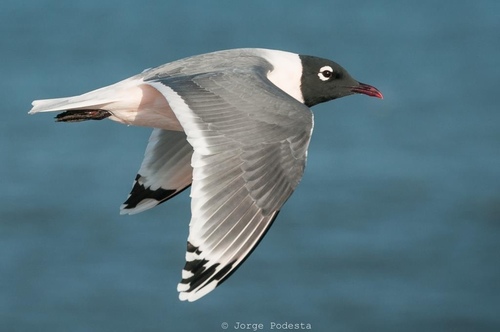
Franklin's Gull
Leucophaeus pipixcan
The 'Prairie Dove' of the American heartland, Franklin's Gull is a striking traveler known for its elegant black hood and its incredible 5,000-mile migration to the South American coast.
Quick Identification
Size
Length: 32-36 cm (12.6-14.2 in); Wingspan: 85-95 cm (33.5-37.4 in); Weight: 220-335 g (7.8-11.8 oz)
Colors
Breeding adults feature a full black hood, dark grey mantle, and a white body often displaying a faint pinkish bloom on the chest. They have a dark red bill and distinctive bold white eye-crescents.
Key Features
- Full black hood with prominent white eye-crescents
- White band separating the grey wing from black wingtips
- Small, dark red bill with a black subterminal band
- Pinkish-white breast during early breeding season
When You’ll See Them
Geographic range
Where Does the Franklin's Gull Live?
Native to the interior of North America, Franklin's Gulls breed across the Great Plains of the United States and the prairie provinces of Canada. This species is a remarkable long-distance migrant, traveling through the central and southern U.S. and Mexico to spend the winter along the Pacific coast of South America, primarily in Chile and Peru. They are frequently spotted in large numbers at stopover points in the American Midwest and along the Gulf Coast during their seasonal journeys.
Basemap © OpenStreetMap contributors
Behavior
Franklin's Gulls are highly social and gregarious birds, often found in massive colonies that can number in the tens of thousands. Unlike many other gulls that are associated with the ocean, these are true birds of the interior, often referred to as 'prairie gulls.' They are remarkably agile in the air, frequently catching insects on the wing like giant swallows. During the summer, they are a common sight following farm machinery, swooping down into freshly turned furrows to feast on exposed grubs and worms.
These gulls are world-class travelers, performing one of the most extensive migrations of any gull species. They move from the northern prairies of North America all the way to the Pacific coast of South America. Because they spend so much time in agricultural areas, they have a relatively comfortable relationship with humans, though they remain wary and will mob intruders who get too close to their floating nests in the marshes.
EverydayEarth exclusive
Camera Tips
To capture Franklin's Gulls on a backyard or trail camera, focus on their attraction to water and open spaces. If you live near their migratory corridor or breeding grounds, a low-profile camera set up near the edge of a shallow birdbath or a backyard pond is ideal. These gulls are ground-foragers, so aim your camera about 12-18 inches off the ground to get a face-to-face perspective that highlights their unique white eye-crescents and red bills.
Because they are attracted to insects, they are most likely to visit areas with short grass or exposed soil. If you have a large property, placing a camera near a recently mowed field or a tilled garden bed can yield excellent results, especially in the morning when they are most active in their search for earthworms. They are fast-moving birds, so ensure your camera is set to a high-speed trigger or a multi-shot burst mode to capture them in motion without blur.
Lighting is crucial for this species, particularly if you want to capture the elusive 'pink bloom' on their chest feathers. This rosy tint is most visible in the early spring and is best captured in soft, natural light. Position your camera facing north or south to avoid lens flare during the 'golden hours' of sunrise and sunset, which will bring out the delicate textures of their plumage. During migration peaks, keeping the camera active throughout the day is recommended, as large flocks may descend suddenly to rest and refuel.
Similar Species
Species that look similar or are commonly confused with Franklin's Gull.
Frequently Asked Questions
Record Franklin's Gull at your habitat
Connect a camera to start building your own species record — AI identifies every visitor automatically.