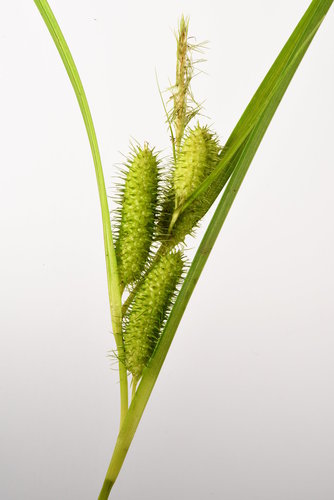
Frank's sedge
Carex frankii
A champion of the rain garden, Frank's sedge is easily recognized by its distinctive, bristly seed heads that look like miniature green bottle brushes. This hardy native plant is as functional as it is beautiful, providing essential erosion control and habitat for backyard amphibians.
Quick Identification
Size
Height of 30–90 cm (1–3 feet); leaf width 5–10 mm (0.2–0.4 inches)
Colors
Bright green foliage; seed spikes are pale green when young, turning to a straw-yellow or tan as they mature
Key Features
- Dense, bristly cylindrical seed spikes resembling tiny bottle brushes
- M-shaped leaf blades when viewed in cross-section
- Stiff, upright stems (culms) that remain green late into the season
- Distinctive squarrose (spreading) scales on the seed heads
When You’ll See Them
Behavior
In the backyard ecosystem, this plant acts as a structural anchor. It doesn't migrate or move, but its life cycle is closely tied to the seasons. In late spring, it sends up its signature stiff stalks, which eventually support heavy, bristly seed heads. These heads are tough enough to withstand summer storms, providing a consistent perch for dragonflies and a sturdy hideout for tree frogs seeking moisture during the heat of the day.
EverydayEarth exclusive
Camera Tips
Lighting is the most important factor for plant photography. Set your camera to face East or West so that the low-angle sun during the 'golden hours' (7-9 AM or 5-7 PM) back-lights the bristly seed heads. This creates a halo effect that makes the plant pop against the background. If you are using a camera with motion-trigger settings, be aware that wind can cause the stalks to sway, potentially filling your SD card with 'empty' clips. To avoid this, lower the sensitivity or use a 'time-lapse' mode to capture the plant's growth over several weeks.
Because Frank's sedge is a hub for biodiversity, your camera can act as a window into a tiny world. Point the camera at the base of the plant to catch sightings of American Toads or Gray Treefrogs that utilize the damp shade. During the late summer months, the stiff stems often serve as 'landing strips' for pollinators and predatory insects like damselflies. If your camera has a macro or close-up lens capability, aim it directly at a mature seed spike to record the various beetles and moths that may come to feed on the seeds or lay eggs in the foliage.
Frequently Asked Questions
Record Frank's sedge at your habitat
Connect a camera to start building your own species record — AI identifies every visitor automatically.