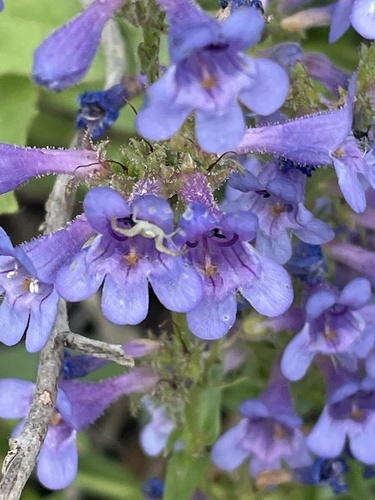
Front Range Beardtongue
Penstemon virens
A low-growing treasure of the Rockies, the Front Range Beardtongue transforms the foothills into a sea of sapphire every spring. This hardy wildflower is a favorite for hummingbirds and a stunning subject for backyard macro-photography.
Quick Identification
Size
Height: 10–40 cm (4–16 inches); Flower length: 1–1.8 cm (0.4–0.7 inches)
Colors
Brilliant blue to deep violet tubular flowers; dark green, glossy basal leaves; reddish-purple stems
Key Features
- Low-growing mats of shiny, evergreen basal leaves
- Tubular blue-violet flowers with two distinct lips
- Short, fine hairs on the stem but not on the flowers
- Native specifically to the Front Range of Colorado and Wyoming
When You’ll See Them
Behavior
The Front Range Beardtongue is a hardy perennial that thrives in the challenging environments of the Rocky Mountain foothills. Unlike many taller penstemons, this species stays low to the ground, forming dense mats of evergreen leaves that provide year-round ground cover. During its blooming season, it sends up multiple stalks crowded with flowers, creating the famous 'blue mist' effect that characterizes the Colorado foothills in early summer.
This species plays a vital role in the local ecosystem by acting as an early-season nectar source. It has a symbiotic relationship with native long-tongued bees and hummingbirds, who are perfectly adapted to reach the nectar hidden deep within its tubular blossoms. While it doesn't 'behave' in the animal sense, it is highly reactive to moisture; a wet spring will result in a spectacular, dense carpet of blue, while dry years may see more subdued blooming.
EverydayEarth exclusive
Camera Tips
To capture the best images of Front Range Beardtongue, you need to think like a macro photographer. Because this plant is low-growing, mount your camera on a ground-level stake or a very short tripod, ideally only 6 to 12 inches off the forest floor. Angle the lens slightly upward to capture the interior of the 'throat' of the flowers, where the unique 'beardtongue' (the sterile stamen) is visible. This perspective also allows you to catch the sky or forest canopy in the background, providing a beautiful bokeh effect behind the blue blooms.
Since these flowers are a magnet for wildlife, use a high-sensitivity motion trigger or a 'near-field' AI setting if your camera supports it. This will allow you to capture the rapid movements of Broad-tailed Hummingbirds or Mason Bees as they visit the flowers. Set your camera to take short 10-second video clips or high-speed bursts, as pollinators rarely stay on a single stalk for more than a few moments. Morning light is generally superior for this species, as it highlights the dew on the glossy leaves and the vibrancy of the blue petals without the harsh shadows of the midday sun.
If your camera has a time-lapse feature, Front Range Beardtongue is an excellent subject for a multi-day study. Position the camera during the last week of May and set it to take one photo every 30 minutes. You can capture the fascinating process of the flower stalks rising from the basal mat and the sequential opening of the buds from the bottom of the stalk to the top. Ensure your camera is well-camouflaged if placed in public hiking areas, though in a backyard setting, the plant's small size makes it easy to tuck a camera into a nearby rock or log for a natural look.
Similar Species
Species that look similar or are commonly confused with Front Range Beardtongue.
Frequently Asked Questions
Record Front Range Beardtongue at your habitat
Connect a camera to start building your own species record — AI identifies every visitor automatically.