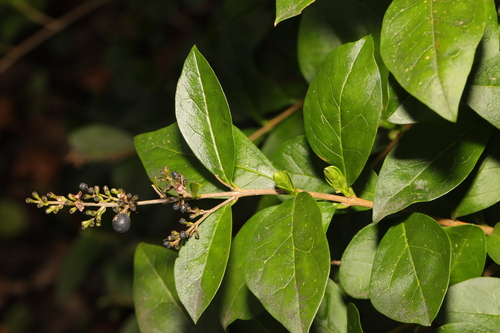
garden privet
Ligustrum ovalifolium
The garden privet is more than just a privacy screen; it's a bustling hub for pollinators and a sanctuary for nesting birds. Its year-round foliage and seasonal berries make it a focal point for backyard wildlife discovery.
Quick Identification
Size
3-4.5m (10-15ft) height; 2-3m (6-10ft) spread
Colors
Glossy deep green foliage; creamy white flowers; dark purple-black berries
Key Features
- Oval, glossy deep green leaves
- Dense panicles of white, tubular flowers
- Small, clusters of dark purple or black berries
- Fast-growing, dense upright habit
When You’ll See Them
Loading activity data...
Behavior
Garden privet is a vigorous, semi-evergreen shrub that serves as a vital structural element in suburban ecosystems. While often managed as a manicured hedge, it naturally grows with an upright, arching habit when left unpruned. Its dense branching provides a secure 'high-rise' habitat for small birds like dunnocks and house sparrows, offering protection from wind and predators throughout the year. The plant is particularly known for its heavy, honey-like fragrance during the mid-summer bloom, which can perfume an entire garden and draw in life from blocks away.
As the seasons change, the privet’s role shifts. In the summer, it acts as a major nectar hub for generalist pollinators, including honeybees and various butterfly species. By winter, it transforms into a crucial food bank. Although the berries are toxic to humans and many pets, they are a high-energy food source for various bird species such as thrushes and waxwings. This plant is a master of adaptation, thriving in a variety of soil types and levels of air pollution, making it a staple of urban wildlife gardening.
EverydayEarth exclusive
Camera Tips
To capture the high-speed action of pollinators, mount your camera approximately 12-20 inches away from a blooming flower panicle. Use a 'Macro' or 'Close-up' focus setting if your hardware supports it. Garden privet flowers attract a variety of bees and butterflies; to get the best results, ensure the camera is facing East or South to catch the morning sun, which triggers the highest nectar production and insect activity. High shutter speeds are a must to freeze the motion of buzzing wings.
For bird watchers, the privet hedge is an ideal location for a 'hidden' camera. Instead of pointing the camera at the outside of the hedge, try mounting it on a sturdy interior branch looking along a gap or 'tunnel' inside the foliage. Small birds use these internal branch-highways to move safely away from the eyes of hawks. Setting your trigger sensitivity to 'High' is essential here, as these birds move incredibly fast and can disappear into the leaves in a fraction of a second. If your camera has a pre-roll feature, keep it active.
During the winter months, the dark berries become the star attraction for larger birds. Position your camera at eye-level with the heaviest clusters of fruit. Since berries often grow on the outer tips of the branches, wind can cause false triggers. To combat this, use a camera with 'Zone Detection' to focus only on the specific cluster where a bird is likely to perch, or adjust the sensitivity to ignore the swaying of the branches while still catching the weight-shift of a landing bird.
Lastly, pay attention to lighting. The deep green, glossy leaves of the garden privet can cause cameras to overexpose, especially when the bright white flowers are in bloom. If your camera allows manual exposure compensation, setting it to -0.3 or -0.7 can help preserve the detail in the white petals and ensure the colors of visiting insects or birds aren't washed out in the highlights.
Similar Species
Species that look similar or are commonly confused with garden privet.
Frequently Asked Questions
Record garden privet at your habitat
Connect a camera to start building your own species record — AI identifies every visitor automatically.