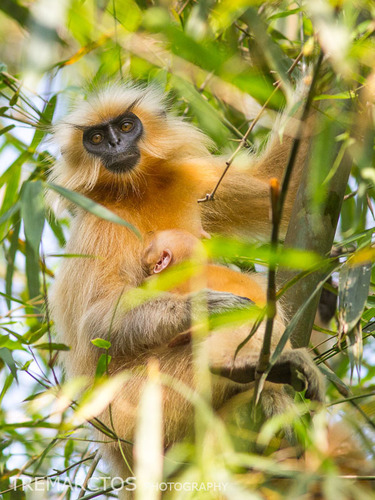
Gee's Golden Lutung
Trachypithecus geei
Glimmering like sunlight through the leaves, Gee's Golden Lutung is one of the rarest and most beautiful primates on Earth. Found only in the secluded forests of India and Bhutan, this golden langur is a masterpiece of Himalayan biodiversity.
Quick Identification
Size
Body length 50–75 cm (20–30 in); tail length 70–100 cm (28–39 in); weight 9.5–12 kg (21–26 lbs).
Colors
Shimmering golden to creamy-white fur; jet-black hairless face; darker golden flanks in adult males.
Key Features
- Rich golden-cream coat that glows in sunlight
- Distinctively long tail, often longer than the body
- Deep black face with prominent brow ridges
- Arboreal specialist with slender limbs
When You’ll See Them
Geographic range
Where Does the Gee's Golden Lutung Live?
Gee's Golden Lutung is native to a very small and isolated pocket of South Asia, specifically found in the foothills of the Black Mountains of Bhutan and the neighboring state of Assam in Northeast India. Its core range is strictly bounded by four geographic barriers: the Brahmaputra River to the south, the Manas River to the east, the Sankosh River to the west, and the high Himalayas to the north. There are no introduced populations outside of this tiny, endemic footprint, making it one of the most geographically restricted primates in the world.
Basemap © OpenStreetMap contributors
Behavior
Gee's Golden Lutungs are highly social and primarily arboreal primates that spend the vast majority of their lives in the upper canopy. They live in cohesive groups, typically numbering around eight individuals, though larger troops of up to 50 have been recorded. These groups are usually unimale-multifemale units, where a single dominant male protects and leads several adult females and their young. Social bonding is critical to the troop, maintained through frequent grooming sessions and a variety of subtle vocalizations.
These monkeys follow a diurnal rhythm, beginning their activity at dawn. They are famously shy and wary of human contact, though habitat encroachment has forced some populations into closer proximity with forest-edge villages. They are most active in the early morning and late afternoon, dedicating several hours during the heat of midday to resting and socializing in the shade of dense foliage. Unlike some other primates, they rarely descend to the forest floor, preferring to leap across branches with incredible agility.
EverydayEarth exclusive
Camera Tips
Capturing the Gee's Golden Lutung on camera is a significant challenge due to their strictly arboreal nature. To get high-quality footage, you must move your equipment off the ground. Using specialized tree mounts or heavy-duty straps, position your camera 5 to 12 meters high in the mid-canopy. Look for 'arboreal corridors'—large, horizontal branches that connect different sections of the forest canopy—as langurs use these repeatedly as highways to move between feeding sites.
The most striking feature of this species is its golden fur, which can be difficult to photograph correctly. In direct, harsh sunlight, the cream-colored fur often overexposes and loses all detail. To prevent this, aim your camera toward the north or south to avoid the direct arc of the sun, and if your device has manual settings, dial the exposure compensation down by -0.5 or -1.0. This ensures the shimmering texture of their coat is preserved against the darker green forest background.
Focus your efforts near seasonal food sources. During the dry season, the bright red flowers of the Silk Cotton tree (Bombax ceiba) act as a natural magnet for these monkeys. Positioning a camera with a clear view of a flowering or fruiting tree will yield much higher success rates than random placement. Avoid using artificial bait, as this species has a highly specialized digestive system and human food or high-sugar fruits can be physically harmful to them.
Because they are active early, ensure your camera's trigger speed is set to its fastest setting. While they are often sedentary while feeding, their leaps between trees are lightning-fast. A burst mode of 3-5 photos per trigger is the best way to capture a clear shot of a langur in mid-air or a mother moving with an infant clinging to her chest.
Frequently Asked Questions
Record Gee's Golden Lutung at your habitat
Connect a camera to start building your own species record — AI identifies every visitor automatically.