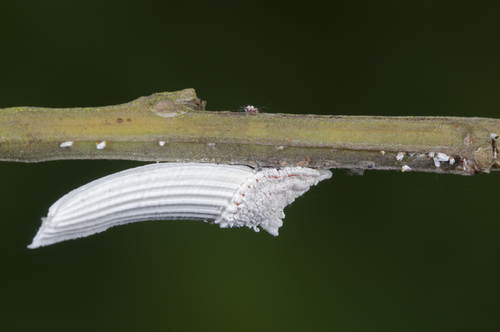
Genista Giant Scale Insect
Crypticerya genistae
A miniature marvel of the backyard, the Genista Giant Scale Insect is famous for its architectural white egg sacs and striking orange body. Often found hidden on garden stems, these tiny sap-drinkers create a snowy spectacle for those who look closely.
Quick Identification
Size
Adult females have a body length of 4–6 mm (0.15–0.23 in), but their massive white ovisac can reach 17–19 mm (0.66–0.75 in) in length.
Colors
Bright light-orange body with contrasting solid black legs; egg sac is a brilliant, pure white with a fluted texture.
Key Features
- Massive white fluted ovisac up to 0.75 inches long
- Light orange body with distinct black legs
- Ovisac held either erect or parallel to the plant stem
- Often attended by ants seeking honeydew
When You’ll See Them
Geographic range
Where Does the Genista Giant Scale Insect Live?
This species is primarily native to the Neotropical regions, with deep roots in the Caribbean basin and parts of Central and South America. In recent decades, it has established a significant presence in the United States, particularly across the state of Florida, where the warm and humid climate mimics its natural home. It is frequently found in managed landscapes and nurseries, often hitching a ride to new territories on ornamental plants and shrubs.
Basemap © OpenStreetMap contributors
Behavior
The Genista Giant Scale Insect is a fascinating, though often stationary, member of the scale family. As adults, the females settle onto the stems or leaf midribs of their host plants, using specialized piercing-sucking mouthparts to drink nutrient-rich phloem. Because they consume vast quantities of sap, they excrete a sticky, sugar-rich liquid known as honeydew. This honeydew is a primary food source for local ant colonies, which in turn act as a private security force, protecting the scale insects from ladybugs and other predators.
The most dramatic behavior of this species is the production of the ovisac. As the female matures, she secretes a complex waxy structure that can grow to several times her body size. This sac acts as a protective nursery for hundreds of bright orange eggs. Once the eggs hatch, the tiny 'crawlers'—the only mobile stage of the insect—disperse across the plant or hitch a ride on the wind to find new territory. Despite their slow-moving nature, they are highly successful colonizers of backyard landscapes.
EverydayEarth exclusive
Camera Tips
To capture the Genista Giant Scale Insect on camera, you need to think small and focus on macro capabilities. These insects are largely stationary, which makes them excellent subjects for close-up photography, but their small size means you must position your camera within 6 to 10 inches of the host plant's stem. Look for plants showing signs of 'sooty mold' (a black fungus that grows on their honeydew) or heavy ant activity, as these are clear indicators that scale insects are nearby.
Lighting is your biggest challenge with this species. The brilliant white ovisac is highly reflective and can easily 'wash out' in a photo, losing all the beautiful fluted detail. If your AI-powered camera has adjustable lighting, turn down the intensity of the infrared LEDs at night, or position the camera so it captures side-lighting during the golden hours of morning or evening. This side-lighting will create shadows in the ridges of the egg sac, making the texture pop in your images.
Because these insects don't move enough to trigger standard PIR (Passive Infrared) motion sensors, the best way to monitor them is through a time-lapse setting. Set your camera to take a high-resolution photo every 15 to 30 minutes. Over several days, this will allow you to see the growth of the waxy sac or the dramatic emergence of the tiny orange crawlers. If you are lucky, you might even capture the fascinating 'farming' behavior of ants as they interact with the scale insects.
Similar Species
Species that look similar or are commonly confused with Genista Giant Scale Insect.
Frequently Asked Questions
Record Genista Giant Scale Insect at your habitat
Connect a camera to start building your own species record — AI identifies every visitor automatically.