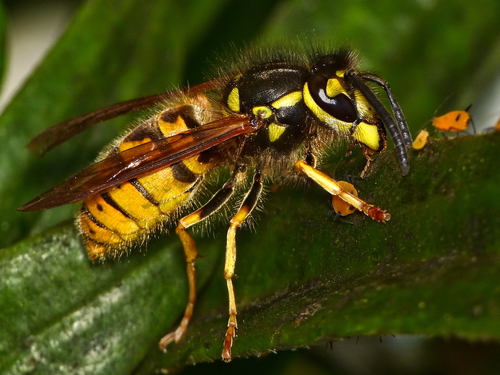
German Yellowjacket
Vespula germanica
The German Yellowjacket is a master of adaptation, thriving in the heart of our suburbs. These strikingly patterned social wasps are the architects of hidden underground cities and essential, if misunderstood, backyard predators.
Quick Identification
Size
Workers: 12-15 mm (0.47-0.59 in); Queens: up to 20 mm (0.8 in)
Colors
Bright yellow and black bands; black markings on the abdomen often appear as distinct spots or diamonds separate from the black bands.
Key Features
- Three tiny black dots arranged in a triangle on the face (clypeus)
- Vivid yellow and black abdominal patterns with black spots
- Stocky body with a narrow 'wasp waist' and translucent wings
When You’ll See Them
Behavior
German Yellowjackets are highly social insects that live in large, sophisticated colonies. Unlike many other wasp species that build visible hanging nests, these yellowjackets are opportunistic nesters, frequently selecting underground cavities, hollow logs, or structural voids within human homes. A single colony can grow to house thousands of individuals by late summer, all working under a single queen to expand the nest and feed the developing larvae.
These insects are famously persistent scavengers, particularly during the late summer and autumn months. While they spend early spring hunting for protein to feed their young, their dietary needs shift toward sugars as the colony matures. This shift is often what leads to increased interactions with humans, as the wasps are drawn to trash cans, fallen fruit, and outdoor dining areas. While they are generally not aggressive while foraging, they are fiercely protective of their nest and will sting repeatedly if they perceive a threat to their colony.
EverydayEarth exclusive
Camera Tips
To capture high-quality footage of German Yellowjackets, you need to focus on their feeding and hydration habits. During the peak of summer, set up your camera near a 'watering hole'—a shallow dish of water with pebbles for them to land on works perfectly. Position the camera at a low angle, roughly 6 to 10 inches away if your camera has a macro lens or a close-focusing capability. Because these insects move extremely fast, use the highest frame rate available (60fps or higher) to ensure smooth playback when you slow the footage down to observe their intricate wing movements.
Baiting is the most effective way to ensure a visit. In the spring and early summer, protein-based baits like a small piece of wet cat food or deli meat will attract workers hunting for the colony. By late summer, switch to sweet lures such as overripe peaches, fermented fruit, or a sponge soaked in sugar water. Place the bait on a steady platform in a sun-lit area; the bright natural light will help the camera's sensor capture the vibrant yellow and black contrast without blurring. Avoid placing the camera directly at a nest entrance for safety reasons; instead, find a flight path or a frequent foraging spot about 10-20 feet away from the hive.
When setting your triggers, keep in mind that insects are small and may not always trip a standard PIR motion sensor. If your camera allows for 'Time Lapse' mode or has an 'Always On' AI-detection feature specifically for insects, use those instead. Early afternoon provides the best lighting for capturing the iridescent shimmer of their wings. Ensure the background is a contrasting dark color, like deep green foliage, to make the bright yellow of the wasp 'pop' in your frame.
Similar Species
Species that look similar or are commonly confused with German Yellowjacket.
Frequently Asked Questions
Record German Yellowjacket at your habitat
Connect a camera to start building your own species record — AI identifies every visitor automatically.