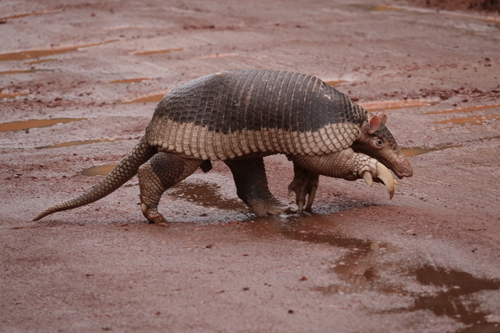
Giant Armadillo
Priodontes maximus
The 'Ecosystem Engineer' of South America, the Giant Armadillo is a reclusive giant that shapes the wilderness with its massive claws. Discover the secrets of this vulnerable nocturnal titan.
Quick Identification
Size
Body length 75–100 cm (30–39 in), tail length 50 cm (20 in); weight 18.7–32.5 kg (41–72 lbs) in the wild.
Colors
Dark brown to blackish carapace with a distinct yellowish-white band along the lower edge of the shell; pale, hairless underside.
Key Features
- Massive, sickle-shaped central claw on the front feet reaching up to 20 cm
- Flexible carapace with 11 to 13 movable bands
- Conical head with up to 100 small, peg-like teeth
- Heavy, thick-set body significantly larger than any other armadillo species
When You’ll See Them
Geographic range
Where Does the Giant Armadillo Live?
Native to the South American continent, the Giant Armadillo occupies a vast territory east of the Andes. Its core range includes the Amazon Basin and the Pantanal, extending from Venezuela and the Guianas in the north down through Brazil, eastern Bolivia, and Paraguay, reaching its southern limit in northern Argentina. They are specialists of undisturbed wilderness and are rarely found in areas with high human activity or significant agricultural development.
Basemap © OpenStreetMap contributors
Behavior
The Giant Armadillo is a solitary and elusive nocturnal powerhouse, spending its daylight hours deep within complex burrows. These animals are true ecosystem engineers; the tunnels they excavate for shelter are so large and well-constructed that they frequently serve as critical refuges for dozens of other species once the armadillo moves on. Unlike their smaller relatives, they are rarely seen by humans and are known for their shy, retiring nature.
When active at night, they are tireless foragers, moving with a surprising turn of speed when necessary. While they are generally peaceful, they can defend themselves using their formidable front claws. Social interactions are rare outside of the breeding season, and mother armadillos typically give birth to just one or two young, which stay protected within the burrow system during their early development.
EverydayEarth exclusive
Camera Tips
Capturing a Giant Armadillo on camera requires targeting their specific 'engineering' sites. Look for fresh burrows that are roughly 40cm wide and 30cm high, often accompanied by a large mound of freshly excavated soil. These animals are creatures of habit but move between several burrows within their large home range. Set your camera at a low height—about 30 to 50 cm off the ground—and angle it slightly upward to capture the underside and the identifying fringe of their carapace.
Because they are strictly nocturnal, a camera with high-quality 'no-glow' or black IR flash is essential. Giant Armadillos can be sensitive to the red glow of standard infrared LEDs, which might cause them to avoid the area in the future. Position the camera about 3 to 5 meters away from a suspected active burrow or a large, recently disturbed termite mound. They are not easily lured by food baits, so site selection is far more important than any lure you might use.
Sensitivity settings should be set to 'High' because, despite their size, their thick armor doesn't always dissipate heat as effectively as furred mammals, sometimes making PIR sensors less responsive. Ensure your camera is capable of rapid-fire bursts or high-definition video; seeing the massive central claw in motion as they dig is one of the most rewarding sights for any wildlife enthusiast. Be patient, as these animals have massive home ranges and may only pass a specific spot once every few weeks.
Frequently Asked Questions
Record Giant Armadillo at your habitat
Connect a camera to start building your own species record — AI identifies every visitor automatically.