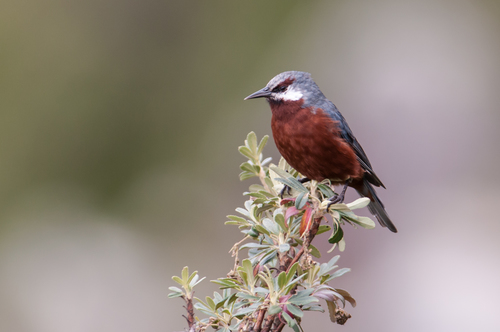
Giant Conebill
Conirostrum binghami
A specialist of the high Andes, the Giant Conebill is an acrobatic master of the Polylepis forests, recognized by its striking rufous underparts and its unique habit of climbing trees like a nuthatch.
Quick Identification
Size
14-16 cm (5.5-6.3 in); Weight 22-27g
Colors
Lead-gray upperparts, deep rufous-chestnut underparts, white cheek patches and lores, and a small white patch at the base of the primaries.
Key Features
- Stout, sharp black bill
- Distinctive white cheek patch and eyebrow
- Rich rufous-chestnut belly and undertail
- Nuthatch-like habit of creeping along tree trunks
When You’ll See Them
Geographic range
Where Does the Giant Conebill Live?
The Giant Conebill is a native of the high Andes in South America, following the mountain chain through Colombia, Ecuador, Peru, Bolivia, and northern Chile. Its presence is strictly tied to the fragmented pockets of Polylepis forest that grow at the timberline, making its distribution naturally patchy. While it is found across a wide latitudinal range, it remains a habitat specialist that rarely wanders far from these ancient, high-elevation trees.
Basemap © OpenStreetMap contributors
Behavior
The Giant Conebill is a specialized high-altitude tanager with habits that more closely resemble a nuthatch or a treecreeper than its conebill relatives. It is famous for its acrobatic foraging style, often seen clinging to the papery, exfoliating bark of Polylepis trees, sometimes hanging upside down to reach insects hidden in the crevices. Unlike many other small Andean birds, it moves with a deliberate, searching pace rather than frantic flitting.
These birds are usually found in pairs or small family groups and are highly territorial during the breeding season. While they are relatively quiet, they maintain contact with soft, high-pitched calls. They occasionally join mixed-species foraging flocks, though they tend to stay within their preferred micro-habitat of twisted mountain woodlands rather than following the flock into open scrub.
EverydayEarth exclusive
Camera Tips
To capture the Giant Conebill on camera, you must position your equipment within or at the edge of a Polylepis grove. Since these birds spend the vast majority of their time prying at bark, mount your camera directly onto a thick, vertical trunk or a large horizontal branch about 5 to 8 feet off the ground. Aiming the lens at a section of the tree where the bark is particularly loose or 'shaggy' will increase your chances of catching them during their unique foraging displays.
Because the high-altitude Andean environment is prone to heavy mist and rapid light changes, use a camera with a fast trigger speed and high ISO capabilities to prevent motion blur. Set your camera to take short, high-definition video clips (10-15 seconds) rather than photos; the way these birds creep and probe into the bark is their most diagnostic behavioral trait and is best viewed in motion.
In terms of timing, the first few hours of sunlight are critical. As the sun warms the trees, the insects beneath the bark become more active, and so do the conebills. If you are setting up a trail camera in a dry area, a small, solar-heated birdbath or a simple water dripper can be an irresistible lure, as liquid water is often scarce or frozen at these extreme elevations. Ensure your camera housing is rugged and weather-sealed to handle the intense UV rays and nocturnal frosts common in the puna zone.
Similar Species
Species that look similar or are commonly confused with Giant Conebill.
Frequently Asked Questions
Record Giant Conebill at your habitat
Connect a camera to start building your own species record — AI identifies every visitor automatically.