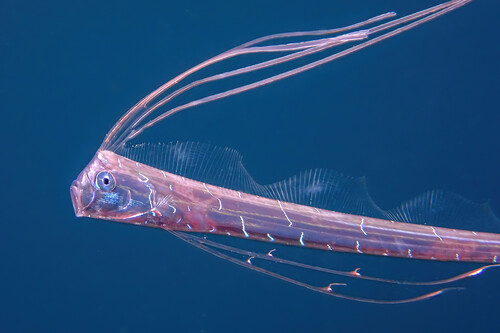
Giant Oarfish
Regalecus glesne
Meet the real-life sea serpent: a shimmering, ribbon-like giant that haunts the ocean's twilight zone. Growing up to 36 feet long, the Giant Oarfish is the world's longest bony fish and a legendary marvel of the deep.
Quick Identification
Size
Typically 3–8 m (10–26 ft) in length, reaching up to 11 m (36 ft); weights up to 270 kg (600 lbs).
Colors
Brilliant silvery skin with dark, irregular streaks and spots; fins are typically a striking bright red or pink.
Key Features
- Extremely elongated, ribbon-shaped body
- Magnificent red dorsal fin crest resembling a crown
- Large, plate-like eyes adapted for the deep
- Scaleless skin covered in silvery guanine
When You’ll See Them
Geographic range
Where Does the Giant Oarfish Live?
The Giant Oarfish is a cosmopolitan species with a massive range across the ice-free oceans of the world. It is native to the temperate and tropical waters of the Atlantic, Pacific, and Indian Oceans, spanning from the coastal waters of the Americas to the deep reaches of the Indo-Pacific. While they are most concentrated in mid-latitude regions, they are occasionally swept by deep-water currents into shallower coastal areas from Norway to New Zealand.
Basemap © OpenStreetMap contributors
Behavior
The Giant Oarfish is a master of the mesopelagic zone, often found drifting vertically in the water column. By hanging head-up and remaining nearly motionless, it uses its large eyes to spot the silhouettes of tiny prey against the faint light from above. This vertical orientation also helps it blend in with the surrounding water, making it nearly invisible to predators looking up from the depths.
Despite their massive size and 'sea serpent' appearance, these giants are gentle filter feeders. They are rarely seen by humans except when they wash ashore or are spotted near the surface, behaviors often associated with injury, strong currents, or seismic activity. While solitary in nature, they are non-aggressive and possess no teeth, relying on gill rakers to trap their food.
EverydayEarth exclusive
Camera Tips
Capturing a Giant Oarfish on camera is the ultimate achievement for any marine wildlife enthusiast, as they typically live hundreds of meters below the surface. To have any chance of a 'backyard' capture, you must live in a coastal area near deep-water drop-offs, such as those found in Southern California, Mexico, or the Mediterranean. Using an underwater ROV (Remotely Operated Vehicle) equipped with high-lumen LED lights is the most effective way to explore the 'twilight zone' where these fish reside.
If you are deploying a stationary underwater trail camera from a deep-water pier or boat, aim for depths below 20 meters during the night, when some deep-sea species migrate closer to the surface. Since oarfish are attracted to light but sensitive to movement, use a camera with a high-quality low-light sensor and wide-angle lens. Standard motion triggers may struggle underwater, so continuous recording or time-lapse modes are often more successful for spotting large, slow-moving silhouettes.
Because they are filter feeders, traditional 'bait' like fish guts won't attract them. Instead, look for areas with high concentrations of krill or jellyfish, which are their primary food sources. Seasonal upwelling events, which bring nutrient-rich deep water to the surface, are the best times to keep your cameras running. Always ensure your camera housing is rated for the specific depth and pressure of your deployment to avoid equipment failure.
Frequently Asked Questions
Record Giant Oarfish at your habitat
Connect a camera to start building your own species record — AI identifies every visitor automatically.