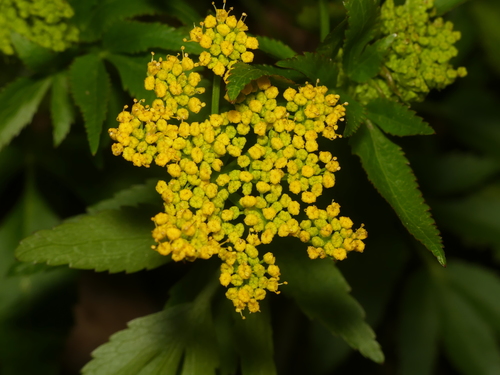
golden Alexanders
Zizia aurea
A spring-blooming powerhouse, Golden Alexanders light up the garden with yellow umbels and serve as a vital nursery for the stunning Black Swallowtail butterfly.
Quick Identification
Size
Height: 30-90 cm (1-3 ft); Spread: 30-60 cm (1-2 ft)
Colors
Bright golden-yellow flower clusters; deep green, glossy foliage; occasionally reddish stems
Key Features
- Flat-topped compound umbels of tiny yellow flowers
- The central flower of each small cluster (umbellet) is stalkless
- Finely serrated, compound leaves with 3-7 leaflets
- Smooth, hairless stems that may be reddish at the base
When You’ll See Them
Behavior
Golden Alexanders are the early-season cheerleaders of the native plant world. While most prairie plants are still waking up, this hardy perennial is already pushing up lush green foliage and preparing its bright yellow blooms for a late spring debut. Its primary "behavior" is its role as a generous host; it is one of the few native plants that can support the lifecycle of the Black Swallowtail butterfly in early spring, providing a critical food source for newly emerged larvae.
In the garden or wild meadow, Golden Alexanders are social plants, often found growing in loose colonies. They aren't aggressive like some of their cousins in the carrot family, but they do readily self-seed, creating a beautiful, naturalized look over several seasons. As the flowers fade in early summer, the plant transitions into a seed-bearing phase where the clusters turn a rich purple-bronze, offering a different kind of visual interest that lasts until the heat of late summer.
EverydayEarth exclusive
Camera Tips
To capture the true magic of Golden Alexanders, don't just point your camera at the flowers—focus on the visitors. This plant is a magnet for tiny beneficial insects and the Black Swallowtail butterfly. Set your camera on a low tripod or a ground mount, positioning the lens roughly 12 to 18 inches away from the flower heads. An angled-down perspective works best to see the flat-topped "landing pads" where pollinators congregate. If your camera has a macro mode or a high-resolution sensor, use it to catch the intricate details of the tiny individual florets.
Timing is everything for this species. Because it blooms in late spring when the sun starts to get harsh, early morning (7–9 AM) or late afternoon (5–7 PM) provides the softest light, which prevents the bright yellow flowers from looking "blown out" or overexposed in your footage. If you are using a trail camera, look for a day with low wind; the tall, thin stems of Golden Alexanders tend to sway easily, which can trigger motion sensors and fill your SD card with videos of just the wind.
For the most rewarding footage, leave your camera active after the blooms have faded. This is when the Black Swallowtail caterpillars appear. They are beautifully striped in green, black, and yellow, and they move slowly enough to create stunning time-lapse videos. Focus your camera on the mid-level leaves and stems where the larvae prefer to hide and feed. Lower your motion sensitivity to avoid false triggers, but set a longer "record time" (at least 20 seconds) to capture the fascinating way these caterpillars consume the foliage.
Similar Species
Species that look similar or are commonly confused with golden Alexanders.
Frequently Asked Questions
Record golden Alexanders at your habitat
Connect a camera to start building your own species record — AI identifies every visitor automatically.