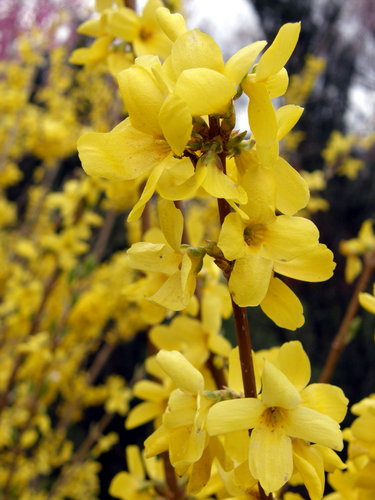
Golden-bell
Forsythia suspensa
The Golden-bell is spring's first masterpiece, draping backyards in a waterfall of brilliant yellow blooms. Its arching branches offer a vital sanctuary for early-season birds and pollinators looking to escape the spring chill.
Quick Identification
Size
Height and spread of 3 to 4 meters (10 to 13 feet) with long, arching branches.
Colors
Vibrant golden-yellow flowers; olive-green to dark green foliage; grey-brown woody stems.
Key Features
- Cascading or weeping growth habit with long, pendulous branches
- Bright yellow, four-petaled flowers appearing before leaves in early spring
- Stems are distinctly hollow between the leaf nodes (internodes)
- Opposite leaves that are simple or sometimes three-lobed at the base
When You’ll See Them
Behavior
The Golden-bell, or weeping forsythia, is one of the first heralds of spring, producing a massive display of yellow blooms before its leaves even emerge. Unlike upright forsythias, this species is known for its long, flexible branches that arch gracefully toward the ground, often rooting where they touch the soil. This creates a dense, tangled thicket that provides excellent low-level cover for backyard wildlife.
As a deciduous shrub, it spends the winter as a collection of rough, square-ish brown stems. Once soil temperatures rise in late March or April, the flower buds swell and burst into a two-week 'golden hour' that attracts early-season pollinators. In the garden, it is a vigorous grower that can quickly fill a space, making it a favorite for natural privacy screens and erosion control on slopes.
EverydayEarth exclusive
Camera Tips
To capture the full glory of the Golden-bell, position your camera at a mid-level height (about 3 to 4 feet) and angle it slightly upward toward the arching, weeping branches. This perspective emphasizes the 'waterfall' effect of the yellow blooms. For the most dramatic shots, try to place the camera so the rising or setting sun is behind the plant; the early morning light will make the thin yellow petals glow with an almost translucent quality, creating a stunning visual for your gallery.
Setting up a time-lapse is the best way to witness the seasonal magic of this species. Golden-bell typically transitions from dormant buds to full bloom over a 7-to-10-day window in early spring. Program your AI-powered camera to take a high-resolution photo every two hours during daylight. When compiled, this reveals the 'explosion' of yellow that defines the species. This blooming period is also a peak time for pollinator activity, so ensure your motion sensors are set to high sensitivity to catch the bees and early butterflies that visit the nectar-rich flowers.
Because the Golden-bell provides dense, tangled cover, it is a favorite staging area for songbirds like Northern Cardinals and Song Sparrows. To capture these interactions, place the camera 5-8 feet away from the perimeter of the shrub. Avoid using a heavy white flash at night, as the reflective yellow petals can 'blow out' the image and lose detail; instead, rely on the camera's natural light optimization. If you want to draw more wildlife into the frame, place a birdbath near the weeping branches—birds will often perch on the Golden-bell stems to dry their feathers, providing the perfect photo opportunity.
Frequently Asked Questions
Record Golden-bell at your habitat
Connect a camera to start building your own species record — AI identifies every visitor automatically.