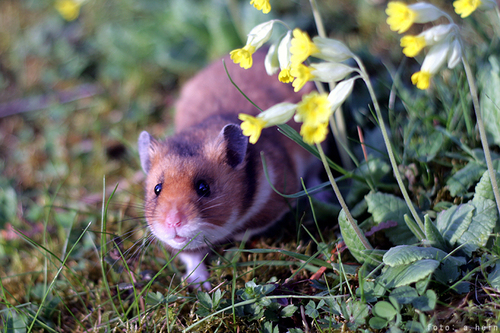
Golden Hamster
Mesocricetus auratus
Though famous as a beloved household pet, the wild Golden Hamster is a rare and endangered master of the Syrian steppe. Known for its industrious food-hoarding and complex burrowing, this tiny rodent is a fascinating subject for nocturnal wildlife enthusiasts.
Quick Identification
Size
13-18 cm (5-7 in) in length; weight ranging from 100-150 grams (3.5-5.3 oz)
Colors
Golden-brown or reddish-orange upper fur with a contrasting creamy white or pale grey belly; dark markings on the cheeks and occasionally a dark chest band.
Key Features
- Massive expandable cheek pouches for food transport
- Very short, stubby tail usually less than 1.5 cm
- Compact, rounded body shape with large, dark eyes
When You’ll See Them
Geographic range
Where Does the Golden Hamster Live?
Native to the Middle East, the Golden Hamster is found in a very specific and restricted geographic area. Its core wild population is centered on the Aleppo Plateau in northwestern Syria and extends slightly across the border into southern Turkey. While their descendants are found in homes across the globe as pets, their wild counterparts are limited to these semi-arid agricultural landscapes and temperate grasslands where the soil is soft enough for deep excavation.
Basemap © OpenStreetMap contributors
Behavior
Golden Hamsters are predominantly nocturnal, emerging from their deep underground burrows shortly after sunset to forage. They are famously solitary and highly territorial; in the wild, an individual will defend its burrow system and surrounding foraging grounds vigorously against any interlopers. They spend much of their waking life searching for seeds and grains, which they stuff into their specialized cheek pouches to carry back to their larders.
These rodents are expert excavators, creating burrows that can reach up to two meters deep with multiple chambers for nesting, food storage, and waste. Because they are preyed upon by owls, snakes, and small carnivores, they are extremely cautious and sensitive to vibrations or sudden movements. In their native range, they may undergo periods of torpor during extreme weather, though they do not truly hibernate in the way larger mammals do.
EverydayEarth exclusive
Camera Tips
To capture a Golden Hamster on camera, you must focus on ground-level activity. These rodents rarely climb and spend almost all their time on the surface running between burrow entrances and food sources. Place your camera no more than 4-6 inches off the ground, ideally angled slightly downward toward a known burrow opening or a clear path through tall grass or agricultural stubble.
Because they are strictly nocturnal, a camera with high-quality infrared (no-glow) LEDs is essential. Standard white flashes will likely spook the animal and prevent it from returning to that spot. Set your camera to 'Burst Mode' or high-frame-rate video; hamsters move with a quick, scuttling gait and can zip across a field of view in a fraction of a second. A fast trigger speed (under 0.3 seconds) is the difference between a clear shot and a blurry golden smudge.
Baiting is highly effective for this species. A small pile of sunflower seeds, dried corn, or high-protein grains placed 3-5 feet in front of the lens will encourage them to pause and fill their cheek pouches, providing excellent footage of their unique feeding behavior. If you are in their native range, look for mounds of excavated earth which indicate active burrow systems, and set your equipment nearby during the dry season when food is more scarce.
Frequently Asked Questions
Record Golden Hamster at your habitat
Connect a camera to start building your own species record — AI identifies every visitor automatically.