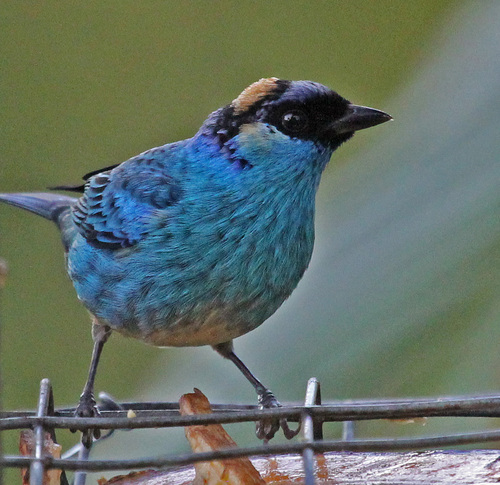
Golden-naped Tanager
Chalcothraupis ruficervix
A dazzling resident of the Andean cloud forests, the Golden-naped Tanager is easily recognized by its shimmering turquoise body and brilliant crown of gold. This social bird is a frequent visitor to forest-edge gardens, bringing a splash of celestial color to the mid-canopy.
Quick Identification
Size
13 cm (5.1 in) in length; weighs approximately 18–24 g (0.6–0.8 oz)
Colors
Deep turquoise-blue body with a velvety black face mask; features a signature golden-yellow to orange-yellow patch on the nape (back of the neck)
Key Features
- Bright golden-yellow patch on the nape
- Velvety black mask extending from the forehead through the eyes
- Vibrant turquoise-blue underparts and darker indigo upperparts
- Small, stout black bill and dark legs
When You’ll See Them
Geographic range
Where Does the Golden-naped Tanager Live?
Native to the rugged landscapes of South America, the Golden-naped Tanager is a staple of the Andean mountain chain. Its geographic footprint spans from the northern highlands of Colombia through the lush cloud forests of Ecuador and Peru, extending as far south as the yungas of Bolivia. This species is an elevational specialist, thriving in the moist, misty environments of the subtropical zone where forest cover remains intact.
Basemap © OpenStreetMap contributors
Behavior
The Golden-naped Tanager is a highly social and energetic bird, frequently observed as a core member of mixed-species foraging flocks. These flocks, which often include other tanagers, honeycreepers, and wood-warblers, move rapidly through the mid-to-upper levels of the forest canopy in search of food. They are agile acrobats, often seen clinging to the undersides of branches or hovering briefly to snatch a berry or an insect from the foliage.
While they are primarily forest-dwellers, they are remarkably adaptable to human presence and are known to frequent gardens and fruit feeders in communities located near montane forest edges. Their presence is often announced by a series of thin, high-pitched vocalizations that serve to maintain contact with their flock mates as they navigate the dense Andean vegetation. Unlike some territorial species, they are generally peaceful and will share a fruiting tree with several other bird species simultaneously.
EverydayEarth exclusive
Camera Tips
To capture high-quality footage of the Golden-naped Tanager, placement is everything. These birds are canopy-dwellers by nature, so mounting your AI camera at eye level or higher is crucial. If you have a balcony or a second-story deck near forest cover, this is an ideal spot. If not, consider using a tall tripod or mounting the camera to a tree limb overlooking a known flight path or a fruiting tree like a Schefflera or a Miconia.
Baiting with fruit is highly effective for this species. They are particularly fond of overripe bananas, plantains, and halved papayas. Secure the fruit to a stable platform feeder to prevent it from falling when the birds land. Because they move with quick, jerky hops, set your camera to a high frame rate or use a 'Short Trigger' setting to ensure you don't just catch a tail feather as they fly off. High-resolution 4K video is recommended to truly showcase the iridescent shimmer of their turquoise feathers.
Lighting in the cloud forest can be tricky and dim. Position your camera so it faces away from the morning sun (North or South) to avoid silhouettes and lens flare. The best shots often occur between 7:00 AM and 9:00 AM when the light is soft but sufficient to illuminate the golden nape. If your camera has adjustable motion sensitivity, set it to 'Medium' to avoid triggers from wind-blown leaves, which are common in their mountainous, breezy habitat.
Similar Species
Species that look similar or are commonly confused with Golden-naped Tanager.
Frequently Asked Questions
Record Golden-naped Tanager at your habitat
Connect a camera to start building your own species record — AI identifies every visitor automatically.