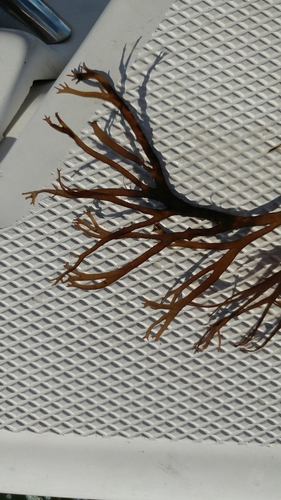
Graceful Red Weed
Gracilaria foliifera
A vibrant and resilient architect of the coastline, the Graceful Red Weed transforms shallow estuaries into lush, crimson underwater meadows. Its ribbon-like fronds provide essential shelter for countless marine species, dancing gracefully with every pulse of the tide.
Quick Identification
Size
Typically 10-30 cm (4-12 inches) in length, though dense mats can spread over several feet in optimal conditions.
Colors
Usually a deep reddish-purple or brownish-red, but can appear olive-green or yellowish if exposed to high levels of sunlight in shallow water.
Key Features
- Flattened, ribbon-like branches
- Dichotomous (Y-shaped) branching pattern
- Rubbery, firm texture that doesn't feel slimy
- Attaches to rocks or shells via a small, disc-shaped holdfast
When You’ll See Them
Behavior
While Graceful Red Weed doesn't move in the traditional sense, it exhibits a fascinating 'behavioral' response to its environment. As a macroalga, it spends its life tethered to the seabed or floating in loose mats in estuaries. It is a highly productive species that responds quickly to nutrient shifts in the water, sometimes growing rapidly to form dense underwater forests that serve as critical nurseries for juvenile blue crabs and small fish.
Unlike many other seaweeds that might wilt or break easily, the Graceful Red Weed is remarkably resilient to wave action. It sways rhythmically with the tide, a motion that helps it maximize sun exposure for photosynthesis and ensures that fresh, nutrient-rich water constantly bathes its fronds. In coastal ecosystems, it acts as a silent engineer, filtering the water and providing a platform for tiny marine invertebrates to graze.
EverydayEarth exclusive
Camera Tips
Capturing the Graceful Red Weed requires a shift from traditional backyard trail cameras to waterproof action cameras or specialized underwater housings. Because this species is most 'active' when submerged, you’ll want to mount your camera at a low-tide mark where the weed is present. Secure your camera to a weighted base or a sturdy dock piling using a swivel mount. The goal is to capture the weed as the tide returns, showing its transition from a slumped, wet mass on the sand to a vibrant, floating ribbon in the current.
Time-lapse mode is your best friend for this species. Set your camera to take a photo every 30 to 60 seconds over a 6-hour tidal cycle. When played back, the Graceful Red Weed appears to 'come alive,' dancing and expanding as the water lifts it. This provides a much more engaging visual than a static photo. If you are shooting in deeper water, remember that water absorbs red light first; you may need a red filter on your lens or post-processing color correction to bring out those deep purples and crimsons that give the plant its name.
Lighting is the biggest challenge for marine flora. If you are setting up in a shallow tide pool, try to capture footage during the 'golden hours' of early morning or late afternoon. The low angle of the sun can penetrate the water at an angle that illuminates the translucent fronds, making them glow with an ethereal red light. Avoid high noon, as the glare off the water's surface can wash out the details of the branching structure.
Lastly, consider the 'co-stars.' Graceful Red Weed is a hub for biodiversity. Position your lens close to the fronds (about 12-18 inches away) to catch the movement of grass shrimp, pipefish, and small crabs that use the weed for cover. If your camera has a macro setting or a close-focus lens, use it! The intricate, Y-shaped branching of the *Gracilaria foliifera* is a beautiful geometric pattern that looks stunning in high-definition close-ups.
Frequently Asked Questions
Record Graceful Red Weed at your habitat
Connect a camera to start building your own species record — AI identifies every visitor automatically.