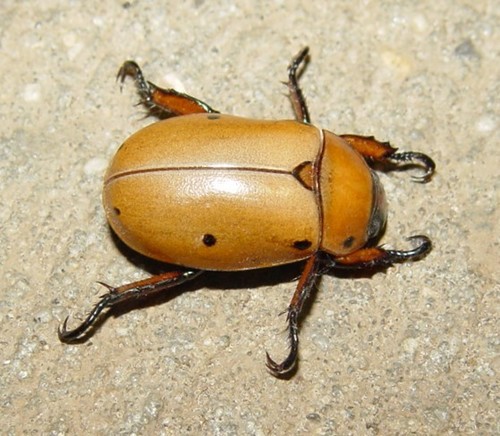
Grapevine Beetle
Pelidnota punctata
With its clay-colored shell and distinctive black spots, the Grapevine Beetle is a summer night staple. This gentle giant of the scarab world is a fascinating backyard find for any nocturnal nature observer.
Quick Identification
Size
20–28 mm (0.8–1.1 inches) in length
Colors
Dull yellow to reddish-tan body with three distinct black spots on each wing cover; dark metallic green or black underside
Key Features
- Pale yellowish-tan oval body
- Six small black spots on the wing covers (three per side)
- Two additional black spots on the thorax
- Dark, iridescent metallic legs and underbelly
When You’ll See Them
Geographic range
Where Does the Grapevine Beetle Live?
The Grapevine Beetle is native to the North American continent, flourishing primarily across the eastern and central regions. Its territory extends from the Atlantic coast of the United States westward to the edge of the Great Plains, reaching as far north as southern Ontario and Quebec in Canada. While most concentrated in the temperate hardwood forests of the American East, they have successfully adapted to suburban environments where ornamental vines and host trees are present.
Basemap © OpenStreetMap contributors
Behavior
The Grapevine Beetle is a nocturnal member of the scarab family known for its distinctive appearance and somewhat clumsy flight. They are most active during the mid-summer months, particularly on warm, humid nights. While they are powerful fliers, their flight path is often erratic and curving, leading them to frequently bump into window screens or porch lights where they eventually settle for the night.
Unlike many other beetles that are considered agricultural pests, the Grapevine Beetle is relatively solitary and rarely appears in numbers large enough to cause significant damage to foliage. They spend their days hiding in dense vegetation or under leaves to avoid predators. When handled, they are entirely harmless to humans, though their hooked legs can feel quite scratchy as they cling to skin or clothing.
EverydayEarth exclusive
Camera Tips
To capture high-quality images of the Grapevine Beetle, focus your efforts on their strong attraction to artificial light. Setting up a backyard camera near an outdoor LED or incandescent bulb is the most reliable method. For the best results, place a white sheet or board behind the light source; this provides a high-contrast background that makes the beetle’s tan body and black spots pop in photographs, while also giving the beetle a flat surface to land on.
Mount your camera at chest height (about 4 to 5 feet) and use a macro lens or a close-focus setting if available, as these beetles are only about an inch long. If your camera uses infrared (IR) for night shots, the beetle may appear washed out; try using a camera with a 'low-glow' flash or a small external LED fill light to preserve the natural yellow-clay color of their elytra. Angle the camera slightly downward if you are placing it near host plants like wild grape or Virginia creeper.
Timing is everything with this species. Ensure your camera is active and has fresh batteries starting in late June through early August. They are most active on nights with high humidity and temperatures above 70°F (21°C). If you are using a trail camera with a motion sensor, set the sensitivity to high, as the beetle's small mass may not always trigger standard sensors unless it flies very close to the lens. Periodic 'time-lapse' mode can be a great backup strategy to ensure you catch them while they are resting near your light setup.
Similar Species
Species that look similar or are commonly confused with Grapevine Beetle.
Frequently Asked Questions
Record Grapevine Beetle at your habitat
Connect a camera to start building your own species record — AI identifies every visitor automatically.