Grass Carp
Ctenopharyngodon idella
A powerful herbivore of the deep, the Grass Carp is nature's underwater lawnmower. With its shimmering metallic scales and incredible jumping ability, this Asian native has become a fascinating, though often elusive, resident of ponds and lakes worldwide.
Quick Identification
Size
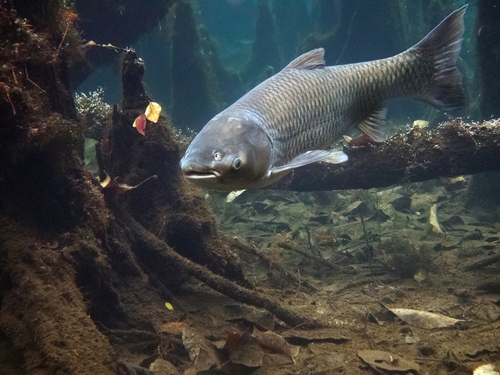
Typically 60–100 cm (24–39 in) and 18–45 kg (40–100 lbs); exceptional individuals can reach 150 cm (59 in) and over 45 kg.
Colors
Dark olive-brown to brassy-yellow back, fading to silvery-white sides and a pale belly; scales have dark outlines creating a cross-hatched pattern.
Key Features
- Torpedo-shaped, elongated body with a broad head
- Absence of barbels (whisker-like sensors) around the mouth
- Large, prominent scales with dark edges
- Short dorsal fin positioned over the pelvic fins
When You’ll See Them
Geographic range
Where Does the Grass Carp Live?
Where Does the Grass Carp Live? Originally native to the massive river systems of the Pacific Far East, the Grass Carp’s range naturally extends from the Amur River along the Sino-Russian border down through the lowland rivers of China to northern Vietnam. Due to their effectiveness at controlling aquatic weeds, they have been introduced to over 70 countries across North America, Europe, and Asia. In the United States, they are commonly found in managed suburban lakes, golf course ponds, and large river basins like the Mississippi, where they thrive in temperate to subtropical conditions.
Basemap © OpenStreetMap contributors
Behavior
Grass Carp are highly specialized herbivores known for their calm yet persistent feeding habits. Unlike many other members of the carp family that stir up mud to find food, Grass Carp are clear-water grazers that primarily consume submerged aquatic plants. They are incredibly efficient, with adults often consuming several times their own body weight in vegetation daily during the peak of summer. This behavior makes them a popular choice for biological weed control in private ponds and managed lakes.
These fish are generally social and can be found in small groups, particularly when young. They are powerful swimmers and are notoriously skittish; a sudden shadow or the vibration of a footfall on a dock can cause them to bolt or even leap dramatically out of the water. While they spend much of their time in deeper water, they frequently move into the shallows during the day to feed or bask in the warmth of the sun near the surface.
EverydayEarth exclusive
Camera Tips
Capturing high-quality footage of Grass Carp requires a creative approach since standard trail cameras are designed for land use. To get the best results, mount your camera at a high angle on a dock, overhanging tree limb, or a dedicated post looking down into a shallow area of the pond. These fish are surface-feeders and baskers, so a downward-facing angle provides the best view of their large, shimmering scales and torpedo-like profile.
Surface glare is your biggest enemy when filming into water. If your camera setup allows for it, use a circular polarizing filter over the lens to cut through reflections and see beneath the surface. Because Grass Carp are cold-blooded, traditional PIR (Passive Infrared) motion sensors often fail to trigger when they swim by. Instead, set your camera to 'Time Lapse' mode with an interval of 1-2 minutes during the sunniest parts of the day. This ensures you catch them as they cruise the shallows to warm up.
To guarantee a close-up, you can use 'green baiting.' Grass Carp are highly attracted to fresh greens; try weighting down a head of romaine lettuce or a bundle of fresh lawn clippings in a shallow, clear spot directly in the camera's field of view. Be sure the bait is in a spot where the sun hits the water directly, as the bright light will help the camera's sensor capture the intricate cross-hatch pattern on their scales. Avoid fast-moving water, as the bubbles and debris can cause false triggers or blurry images.
Frequently Asked Questions
Record Grass Carp at your habitat
Connect a camera to start building your own species record — AI identifies every visitor automatically.