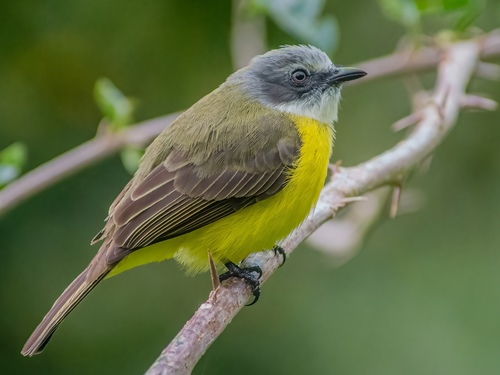
Gray-capped Flycatcher
Myiozetetes granadensis
With its sunny yellow belly and sophisticated gray cap, this vocal flycatcher is a common yet delightful visitor to tropical gardens and forest edges. A master of aerial acrobatics, it brings life and sound to any backyard it visits.
Quick Identification
Size
Length of 16.5–17 cm (6.5–6.7 in); weight ranges from 26–30 g (0.9–1.1 oz)
Colors
Dull olive-brown upperparts with a distinctive gray crown and nape; bright yellow underparts; white throat; dark brown wings and tail without rufous edging
Key Features
- Plain gray crown lacking a bold white eyebrow stripe
- Bright lemon-yellow belly and breast
- Relatively short, stout black bill
- Hidden vermilion or orange crown patch on males
When You’ll See Them
Geographic range
Where Does the Gray-capped Flycatcher Live?
The Gray-capped Flycatcher is a quintessentially Neotropical resident, making its home across the lush landscapes of Central and South America. Its territory begins in the humid lowlands of eastern Honduras and stretches southward through Nicaragua, Costa Rica, and Panama into the vast Amazonian regions of Colombia, Venezuela, and Brazil. You will find them thriving as far south as northern Bolivia and eastern Peru, where they are permanent fixtures in the local ecosystem, rarely wandering from their home territories.
Basemap © OpenStreetMap contributors
Behavior
The Gray-capped Flycatcher is a social and highly vocal bird, often seen in pairs or small family groups. Unlike some of its more aggressive cousins, it is relatively approachable and frequently perches in conspicuous, open locations like fence posts or the outer branches of trees. They are 'sallying' hunters, meaning they sit patiently on a perch and suddenly dart into the air to snatch insects in mid-flight before returning to their home base.
These birds are well-adapted to human presence and are a common sight in suburban gardens and parks throughout their range. They are particularly known for their noisy chatter; they frequently engage in 'wing-shuffling' displays while calling to their mates, making them one of the more animated characters in a backyard setting. While they are mostly insectivorous, they are also quite fond of small berries and will defend a favorite fruiting tree from other small birds.
EverydayEarth exclusive
Camera Tips
To capture the Gray-capped Flycatcher on camera, position your equipment near open perches or 'launching pads.' These birds are sallying predators, meaning they sit on a conspicuous branch, fly out to grab an insect, and often return to the exact same spot. Setting your camera at a height of 5 to 10 feet, angled toward a sturdy, horizontal branch at the edge of a garden or clearing, will yield the best results.
While they are primarily insect-eaters, these flycatchers are also drawn to fruiting trees like Miconia or figs. If you have a fruiting shrub in your yard, aim your camera there during the early morning hours when activity is highest. Because they are vocal and social, you will often hear them before you see them; using a camera with a high-quality microphone can help trigger your interest in the footage even if the bird is slightly out of frame.
Since these birds are fast-moving, use a high shutter speed or 'Sports mode' if your AI camera allows for manual adjustments to reduce motion blur during their quick aerial maneuvers. They are also frequent visitors to elevated birdbaths or garden water features, especially during the heat of the afternoon. A camera placed with a clear view of a water source will capture their energetic bathing rituals, providing some of the most entertaining footage of this species.
Similar Species
Species that look similar or are commonly confused with Gray-capped Flycatcher.
Social Flycatcher
Almost identical in size and color, but has a very prominent white supercilium (eyebrow) that the Gray-capped lacks.
Rusty-margined Flycatcher
Features a white eyebrow stripe and distinctive rufous (reddish-brown) edges on its wing feathers.
Great Kiskadee
Much larger with a massive bill and a bold black-and-white striped head pattern.
Frequently Asked Questions
Record Gray-capped Flycatcher at your habitat
Connect a camera to start building your own species record — AI identifies every visitor automatically.