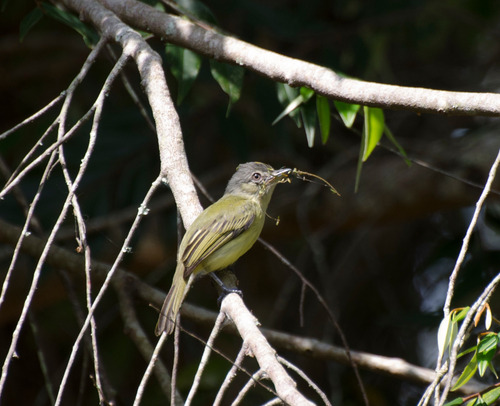
Gray-crowned Flatbill
Tolmomyias poliocephalus
A master of the mid-canopy, the Gray-crowned Flatbill is a charming, grey-capped flycatcher that brings a touch of the Amazon to the backyard. With its architectural nests and acrobatic flight, it is a rewarding find for any wildlife enthusiast.
Quick Identification
Size
Length: 12-13 cm (4.7-5.1 in); Weight: 10-15 g (0.35-0.53 oz)
Colors
Olive-green upperparts with a distinct slate-grey crown; pale yellow underparts; two yellowish wing bars and a thin, whitish eye-ring.
Key Features
- Distinctive slate-grey crown contrasting with olive back
- Broad, flattened bill with a pale lower mandible
- Prominent pale yellowish wing bars and whitish eye-ring
- Small, compact body with a short tail
When You’ll See Them
Geographic range
Where Does the Gray-crowned Flatbill Live?
This small flycatcher is a quintessential South American resident, spanning the vast majority of the continent's tropical lowlands. It is most at home in the lush Amazon Basin and the Atlantic Forest, with its native range stretching across Brazil, Colombia, Peru, Bolivia, Venezuela, and the Guianas. While it avoids the colder Southern Cone countries like Argentina and Chile, its adaptability allows it to thrive from the Caribbean coast down through the heart of the tropics.
Basemap © OpenStreetMap contributors
Behavior
The Gray-crowned Flatbill is a tireless insect hunter that spends most of its day in the mid-to-upper canopy of humid forests. Unlike more gregarious birds, it is often found alone or in pairs, though it frequently joins mixed-species foraging flocks to increase its chances of finding food and avoiding predators. It is known for its 'sally-glean' foraging style, where it sits quietly on a perch before making a sudden, acrobatic dash to snatch an insect from the underside of a leaf.
These birds are particularly famous for their architectural skills; they build distinctive pear-shaped or retort-shaped hanging nests made of woven plant fibers and spider webs, often suspended over water or clearings. While generally shy and staying high in the trees, they are highly vocal, often giving away their presence with a series of high-pitched, buzzy whistles that are a staple sound of the tropical rainforest.
EverydayEarth exclusive
Camera Tips
Capturing the Gray-crowned Flatbill on camera requires a bit of strategy because they prefer the mid-story and canopy. To get them within range of a backyard or trail camera, focus on 'flyway' gaps—small openings in the foliage or edges of gardens where the bird might sally out to catch insects. Position your camera between 5 to 8 feet off the ground, angled slightly upward if you are near dense canopy edges. If you have a water feature like a birdbath or a misting system, this is your best bet for bringing them down to eye level.
Because they are small and fast-moving, use a high-speed trigger setting or a camera capable of capturing 4K video to freeze their motion. They aren't traditional feeder birds, so don't expect them to visit seeds or suet; however, maintaining a garden with native flowering plants that attract small flying insects will naturally draw them in. Setting your camera to 'burst mode' is essential, as these birds rarely stay still for more than a second or two.
Lighting is another crucial factor. Since they often reside in the shaded understory, look for spots where dappled sunlight hits a regular perching branch. If your camera has adjustable ISO, set it to a range that can handle lower light without getting too grainy. The best time to capture activity is in the early morning just after sunrise when insect activity peaks and the birds are most vocal.
Similar Species
Species that look similar or are commonly confused with Gray-crowned Flatbill.
Frequently Asked Questions
Record Gray-crowned Flatbill at your habitat
Connect a camera to start building your own species record — AI identifies every visitor automatically.