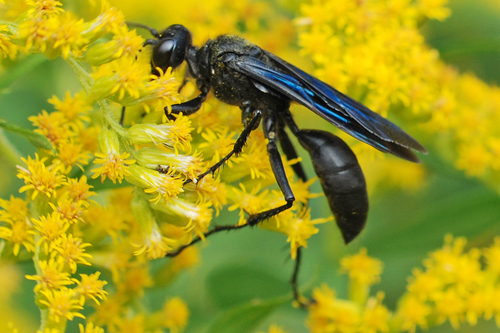
Great Black Digger Wasp
Sphex pensylvanicus
An elegant giant of the summer garden, the Great Black Digger Wasp is a non-aggressive pollinator with a fascinating underground life. Watch as these iridescent beauties patrol your flowers and meticulously craft nurseries for the next generation.
Quick Identification
Size
20–35 mm (0.8–1.4 in) in length
Colors
Solid matte black body and legs; smoky black wings with a distinct blue or violet iridescent sheen
Key Features
- Large, entirely black body with no yellow or white markings
- Deeply constricted 'wasp waist' (petiole)
- Smoky wings with blue/purple iridescence
- Spiny black legs used for digging
When You’ll See Them
Behavior
Despite their imposing size and jet-black appearance, Great Black Digger Wasps are solitary creatures and remarkably docile toward humans. Unlike social wasps such as yellowjackets, they do not have a hive to protect, which means they lack the aggressive 'guarding' instinct. They rarely sting unless they are physically handled or stepped upon, making them safe and fascinating neighbors for backyard observers.
These wasps are famous for their complex nesting behavior. Females act as solo architects, digging vertical burrows in loose or sandy soil that lead to several underground chambers. They are highly efficient hunters, specializing in catching large insects like katydids or grasshoppers. After paralyzing the prey with a precision sting, the female drags the insect back to her burrow—often over great distances—to provide a fresh, living food source for her developing larvae.
EverydayEarth exclusive
Camera Tips
To capture the best footage of a Great Black Digger Wasp, you need to focus on their two primary hubs: the 'nectar bar' and the 'construction site.' For nectar shots, position your camera on a tripod very close to tall, nectar-rich flowers like Mountain Mint, Rattlesnake Master, or Milkweed. Because these wasps are large and move somewhat predictably between blooms, a macro lens or a close-up setting on your trail cam will reveal the stunning iridescent blue flash on their wings that is often invisible to the naked eye.
If you see small mounds of excavated soil in sunny, bare patches of your garden, you have found a nesting site. This is where the most dramatic action happens. Place your camera about 12 inches from the burrow entrance, angled at 45 degrees. Use a high frame rate or 'burst mode' if available, as the most sought-after shot is the female landing with a paralyzed katydid in her mandibles. These 'delivery' moments are brief but showcase the incredible strength of the species.
Lighting is critical when filming a jet-black subject. To avoid the wasp appearing as a featureless black silhouette, ensure the sun is behind the camera or to the side. This side-lighting will highlight the textures of her thorax and the metallic sheen of her wings. Avoid midday shadows by using a camera with good dynamic range, and if possible, set a fast shutter speed to freeze the motion of her wings as she hovers near the burrow entrance.
Frequently Asked Questions
Record Great Black Digger Wasp at your habitat
Connect a camera to start building your own species record — AI identifies every visitor automatically.