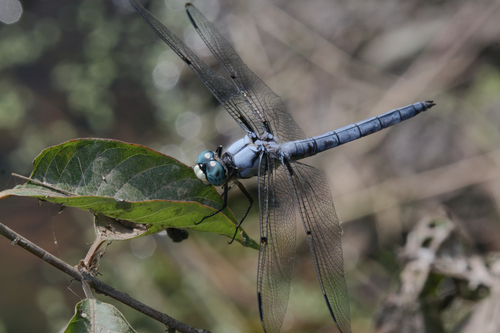
Great Blue Skimmer
Libellula vibrans
One of the largest and most striking dragonflies in the East, the Great Blue Skimmer commands attention with its chalky blue body and stark white face. A master of the swampy woods, it is a favorite for backyard pond watchers and photographers alike.
Quick Identification
Size
50-63 mm (2.0-2.5 inches) in length; wingspan of 85-100 mm (3.3-3.9 inches)
Colors
Mature males are a striking pruinose blue with a bright white face. Females and immatures are brown-to-yellow with a dark dorsal stripe. Both sexes feature prominent black spots at the base, node, and tip of each wing.
Key Features
- Bright white face contrasting with a blue body
- Three distinct dark spots on the leading edge of each wing
- One of the largest skimmer species in North America
- Clear wings except for the black nodes and tips
When You’ll See Them
Geographic range
Where Does the Great Blue Skimmer Live?
The Great Blue Skimmer is native to North America, primarily inhabiting the eastern half of the United States. Its core range stretches from the coastal plains of Texas and the Gulf Coast up through the Mid-Atlantic states, reaching as far north as southern New England and occasionally into southern Ontario, Canada. These dragonflies are most at home in the humid, temperate corridors of the East, where they favor the overlap between dense woodland and still or slow-moving water.
Basemap © OpenStreetMap contributors
Behavior
The Great Blue Skimmer is a formidable aerial predator, often described as the 'lion of the pond.' Unlike many dragonflies that spend their time in continuous flight, this species is a classic perch-hunter. It sits motionless on a shaded twig or leaf, using its massive compound eyes to scan for movement. When a fly or mosquito passes by, the skimmer launches into a high-speed intercept, often catching its prey mid-air before returning to its favorite perch to finish the meal.
Socially, males are intensely territorial. They patrol a specific stretch of shoreline or a sunny clearing, aggressively chasing away rival males or even larger dragonfly species. During the heat of the day, you might observe them performing a behavior called 'obelisking,' where they point their abdomen straight up toward the sun to minimize heat absorption. While they are wary of sudden movements, they are generally indifferent to humans, often allowing a patient observer to get quite close.
EverydayEarth exclusive
Camera Tips
To capture the Great Blue Skimmer on a backyard or trail camera, you must exploit their territorial nature. These insects are 'perchers,' meaning they frequently return to the exact same twig or reed after a hunting flight. Identify a prominent, sun-drenched perch near the water's edge and set up your camera on a tripod. Position the camera at the same height as the perch, aiming for a side-profile or head-on shot to capture that iconic white face and the intricate wing patterns.
Since dragonflies move with lightning speed, use a camera with a high frame rate or a highly sensitive 'Small Animal' or 'Insect' AI trigger. If you are using manual settings, a fast shutter speed (1/2000 sec or higher) is essential to freeze their wings in flight, while a wide aperture (f/4 or f/5.6) will help create a beautiful, blurred background that makes the blue body pop. The best lighting occurs in the early afternoon when the sun is high, highlighting the waxy blue coating of the male's abdomen.
While you cannot 'bait' a dragonfly with food, you can create the perfect stage for them. Placing a few bare bamboo stakes or vertical twigs in a sunny spot near your pond creates an irresistible landing pad for a patrolling male. For the best results, ensure your camera is positioned so the sun is behind you, illuminating the insect directly. Seasonal timing is critical; in the northern parts of its range, you will only have a window from June to August to capture the adults in action.
Similar Species
Species that look similar or are commonly confused with Great Blue Skimmer.
Blue Dasher
Much smaller with vibrant green eyes and a yellow-striped thorax, whereas the Great Blue Skimmer has a white face and is significantly larger.
Eastern Pondhawk
The male Eastern Pondhawk has a green face and lacks the black spots at the nodes and tips of the wings found on the Great Blue Skimmer.
Frequently Asked Questions
Record Great Blue Skimmer at your habitat
Connect a camera to start building your own species record — AI identifies every visitor automatically.