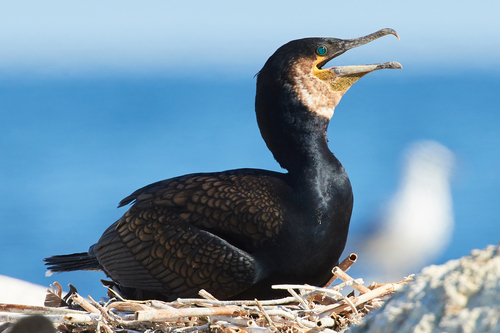
Great Cormorant
Phalacrocorax carbo
A master of the underwater hunt, the Great Cormorant is famous for its iconic wing-drying pose and prehistoric silhouette. Found across the globe, this powerful diver is a captivating visitor to any lakeside or coastal backyard.
Quick Identification
Size
Length: 70–102 cm (28–40 in); Wingspan: 121–160 cm (48–63 in); Weight: 1.5–5.3 kg (3.3–11.7 lbs)
Colors
Adults are mostly black with a bronze-green iridescence. They feature a white patch on the throat and yellow skin at the base of the bill. Breeding adults develop a white patch on the thigh.
Key Features
- Large, dark body with a long, hooked bill
- Yellow gular pouch (throat skin) at the base of the beak
- Distinctive upright perching posture with wings often spread wide to dry
- Emerald green eyes in adult birds
When You’ll See Them
Geographic range
Where Does the Great Cormorant Live?
The Great Cormorant is one of the most widely distributed seabirds in the world, naturally occurring across Europe, Asia, Africa, and Australasia. In North America, it is primarily found along the Atlantic coast, stretching from the Canadian Maritimes down into New England. This adaptable species thrives in almost any country with significant coastlines or large inland water bodies, including the United Kingdom, China, Australia, and South Africa.
Basemap © OpenStreetMap contributors
Behavior
The Great Cormorant is a highly skilled aquatic predator, specialized for pursuit-diving. Unlike many waterfowl, their feathers are not entirely waterproof; this lack of buoyancy allows them to dive deeper and move with incredible speed underwater to catch fish. However, it also means they become waterlogged, leading to their most famous behavior: perching on rocks, docks, or trees with their wings spread wide to dry in the sun and wind.
Social and highly vocal at nesting sites, these birds often gather in large colonies. They are incredibly adaptable, moving between coastal salt marshes and inland freshwater lakes with ease. While they can be wary of humans, they have become increasingly common in urban parks and suburban ponds where fish are plentiful, often returning to the same favorite perching spot day after day.
EverydayEarth exclusive
Camera Tips
To capture the Great Cormorant on your backyard or trail camera, focus your efforts on the water's edge. If you have a private dock, pier, or a large rock overlooking a lake or river, these are prime locations. Cormorants are creatures of habit and love 'sentinel' perches where they can survey the water and dry their wings. Position your camera about 3 to 5 feet off the ground, angled slightly downward toward a prominent perching spot. Since they are large birds, you don't need to be as close as you would for a songbird; a distance of 10 to 15 feet is often ideal to capture their full wingspan during a drying display.
Lighting is crucial for this species because their dark feathers can easily lose detail in the shade or appear as a flat silhouette against bright water. If possible, set your camera so the sun is behind it, illuminating the bird’s iridescent sheen. Because Great Cormorants are strictly diurnal, standard daylight settings work best, but ensure your camera has a fast trigger speed (under 0.5 seconds) to catch them as they land. Their dark plumage can sometimes trick auto-exposure sensors into overexposing the background, so if your camera allows, use a center-weighted metering setting.
While baiting isn't typically effective for these expert hunters, you can effectively lure them by providing an attractive perch. A sturdy, horizontal branch or a floating wooden platform anchored near the shore can be irresistible to a bird looking for a place to rest after a deep dive. For the best results, set your camera to 'Video' or 'Photo + Video' mode. The drying behavior involves subtle wing fluttering and neck stretching that is fascinating to see in high-definition video, while the sounds of their guttural calls can add a prehistoric feel to your captures.
Similar Species
Species that look similar or are commonly confused with Great Cormorant.
Frequently Asked Questions
Record Great Cormorant at your habitat
Connect a camera to start building your own species record — AI identifies every visitor automatically.