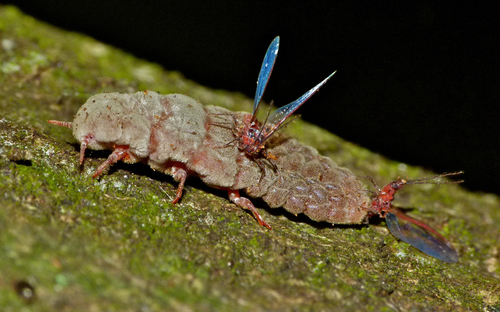
Great Giant Scale
Coelostomidia zealandica
A hidden giant of the New Zealand bush, this pink-bodied insect creates a 'honeydew' forest floor buffet that sustains entire ecosystems.
Quick Identification
Size
Females reach 15 mm (0.6 in) in length; males are much smaller, around 3-5 mm (0.12-0.2 in)
Colors
Females are vibrant pinkish-orange or red, often covered in white snowy wax; males are reddish-brown with a single pair of smoky wings
Key Features
- Large, oval, soft-bodied pinkish female
- Long, hollow waxy anal tube used to excrete honeydew
- Snow-like white waxy secretions covering the body
- Found primarily on the trunks of Beech or Kanuka trees
When You’ll See Them
Geographic range
Where Does the Great Giant Scale Live?
The Great Giant Scale is a proud endemic of Oceania, found naturally nowhere else on Earth except New Zealand. It is widely distributed across both the North and South Islands, maintaining a strong presence wherever its preferred host trees—particularly the Southern Beech—remain standing. Because it is a generalist on several native plant species, it can also be found in established urban parks and backyard gardens that feature New Zealand native flora.
Basemap © OpenStreetMap contributors
Behavior
The Great Giant Scale is a sedentary sap-sucker that spends the vast majority of its life attached to the bark of a host tree. The females are wingless and slow-moving, using their specialized mouthparts to pierce the tree's vascular system and feed on phloem sap. To manage the high sugar content of their diet, they excrete a sweet substance known as honeydew through a long, thread-like waxy tube. This honeydew is a critical food source for native New Zealand birds like the Tui and Bellbird, as well as various lizards and other insects.
Unlike the long-lived females, the males undergo a complete metamorphosis, emerging as tiny, delicate winged insects. They do not have mouthparts and cannot feed; their sole purpose is to fly and locate females for mating before they die within a few days. This species is often noticed by humans not because of the insect itself, but because of the 'sooty mold' fungus that grows on the excess honeydew, coating tree trunks in a velvety black layer.
EverydayEarth exclusive
Camera Tips
Capturing the Great Giant Scale on camera requires a different approach than filming birds or mammals. Because the females are largely stationary, they are perfect subjects for macro photography or high-resolution close-ups. Position your camera very close to the trunk of a known host tree, such as a Black Beech or Kanuka. Look for the distinctive 'white hair' or waxy tubes protruding from the bark crevices, which indicate the insect is feeding inside.
Since these insects don't move fast enough to trigger standard motion sensors, use your camera’s 'Time-Lapse' mode. Set the interval to one frame every 15–30 minutes to observe the production of honeydew droplets at the end of their waxy tubes. If your camera has a macro lens attachment, this is the time to use it; focusing on a 2-inch square area of bark will yield the best results.
Keep an eye out for 'ecological indicators.' If you see Tui or Bellbirds frequently returning to the same spot on a tree trunk to lick the bark, or if the trunk is covered in a black, soot-like fungus, you have found a colony. Placing your camera at these 'honeydew stations' not only captures the scale insects but also the fascinating array of birds and geckos that visit them for a sugary snack.
Similar Species
Species that look similar or are commonly confused with Great Giant Scale.
Frequently Asked Questions
Record Great Giant Scale at your habitat
Connect a camera to start building your own species record — AI identifies every visitor automatically.