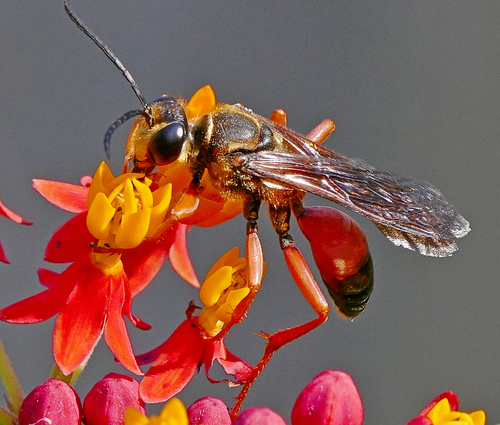
Great Golden Digger Wasp
Sphex ichneumoneus
A masterpiece of nature's engineering, the Great Golden Digger Wasp is a shimmering, solitary architect often found in sunny backyards. Watching this non-aggressive giant hunt and build is a front-row seat to one of the most fascinating life cycles in the insect kingdom.
Quick Identification
Size
20–30 mm (0.8–1.2 inches) in length; wingspan of 30–45 mm (1.2–1.8 inches)
Colors
Brilliant golden-yellow pubescence on the head and thorax; abdomen is tricolored with orange-red at the base, a black middle, and sometimes more orange at the tip; legs are a distinctive reddish-orange.
Key Features
- Dense golden-shimmering hairs on the thorax and face
- Reddish-orange legs and a bicolored orange-and-black abdomen
- Large, solitary build with a thin, elongated 'wasp waist'
- Strong, fast flight often carrying heavy prey like crickets
When You’ll See Them
Behavior
The Great Golden Digger Wasp is a gentle giant of the insect world. Unlike social wasps such as yellowjackets, these are solitary insects, meaning each female works alone to build a nest and provide for her young. Because they have no hive to defend, they are remarkably non-aggressive toward humans and rarely sting unless physically handled. They are often seen hovering low over the ground in search of a suitable spot to excavate their burrows.
The engineering skills of this species are a marvel to watch. A female will dig a vertical tunnel in sandy or loose soil that leads to several underground chambers. After the nest is ready, she hunts for crickets, katydids, or grasshoppers, paralyzing them with a precise sting. She then transports the prey back to the nest, performs a unique 'safety check' by entering the burrow alone before dragging the prey inside, and lays an egg on it to provide a fresh meal for her developing larva.
EverydayEarth exclusive
Camera Tips
To capture high-quality footage of the Great Golden Digger Wasp, you need to think like a surveyor. Look for patches of bare, sunny earth or sandy garden beds where you see small mounds of fresh soil with a hole roughly the diameter of a nickel. This is the entrance to a burrow. Place your camera on a mini-tripod or directly on the ground, positioned about 12 to 18 inches away from the hole. An angle that looks slightly across the entrance rather than straight down into it will better capture the wasp’s profile as she enters and exits.
Because these wasps are incredibly fast, your camera's trigger speed is critical. If using a trail camera, set it to the 'Fastest' trigger interval and use the 'Burst' photo mode or high-definition video. The 'Holy Grail' shot for backyard observers is the moment the wasp lands with her paralyzed prey; she will typically drop the cricket right at the edge of the hole to inspect the nest first. If your camera has a macro lens attachment or a 'close-focus' setting, now is the time to use it to capture the shimmering golden hairs on her thorax.
Lighting is your best friend and your worst enemy with this species. They are most active in full, direct sunlight, which makes for great visibility but can cause 'blowout' on their reflective golden bodies. Try to position your camera so the sun is at a 45-degree angle to the burrow entrance. This provides enough light to reveal her metallic sheen without washing out the details. If your camera has a high-frame-rate video setting (60fps or higher), use it—slowing down the footage later will reveal the fascinating way she uses her mandibles and legs to move earth.
Frequently Asked Questions
Record Great Golden Digger Wasp at your habitat
Connect a camera to start building your own species record — AI identifies every visitor automatically.