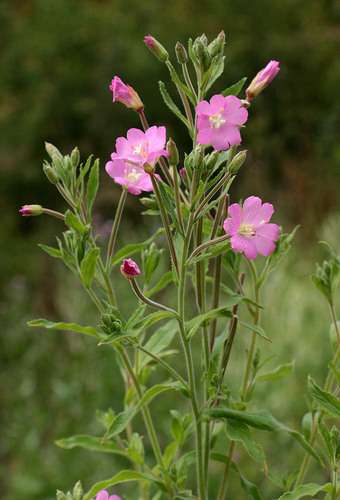
Great Willowherb
Epilobium hirsutum
A towering beauty of the wetlands, the Great Willowherb lights up damp garden corners with its notched pink petals and soft, velvety stems. Known affectionately as 'Codlins and Cream,' this vibrant wildflower is a vital sanctuary for magnificent moths and busy bees.
Quick Identification
Size
Height ranges from 80cm to 200cm (2.6 to 6.5 feet); flowers are approximately 1.5 to 2.5cm (0.6 to 1 inch) in diameter.
Colors
Brilliant rose-pink to deep magenta petals with a distinct white-cream center; stems and leaves are light to mid-green and covered in fine white hairs.
Key Features
- Four notched petals forming a cross-shape
- Soft, hairy stems and leaves that feel velvety
- Leaves that clasp the stem directly without a stalk
- Tall, multi-branched upright growth habit
When You’ll See Them
Behavior
The Great Willowherb is a vigorous perennial plant known for its striking presence in damp landscapes. While it doesn't move like an animal, it exhibits 'behavior' through its rapid colonization of wet soils via a network of underground runners (rhizomes). It is famous for its distinct fragrance; when the leaves are crushed, they emit a scent reminiscent of stewed apples or cream, earning it the delightful folk name 'Codlins and Cream.'
Ecologically, this species acts as a bustling community hub. During the day, it is a primary nectar source for long-tongued bees and hoverflies. At night, it becomes a beacon for moths. It is particularly important as a food plant for the larvae of the Elephant Hawk-moth. After flowering, the plant produces long, thin pods that burst open to release hundreds of seeds attached to silky white hairs, which use the wind to find new places to grow.
EverydayEarth exclusive
Camera Tips
Capturing the Great Willowherb requires a different strategy than mobile wildlife because your subject is stationary but susceptible to movement from the wind. To get the best results, mount your camera on a sturdy stake or a tripod rather than a swaying branch. Position the camera at roughly 4 or 5 feet high, angling it slightly downward to capture the clusters of flowers at the top of the plant. If your camera has a 'Macro' or close-focus mode, use it to highlight the unique hairy texture of the stems and the notched details of the petals.
Because this species is a magnet for insects, it’s an excellent 'lure' for capturing high-quality pollinator footage. Set your AI camera to its highest sensitivity or use a high-speed video mode. This will allow you to record the rapid movements of bees during the day and the spectacular Elephant Hawk-moth at dusk. To avoid motion blur caused by the plant swaying in the breeze, try to position your camera in a spot that is somewhat sheltered by other vegetation or a fence, or plan your recording sessions for calm mornings when the air is still.
Time-lapse is your best friend when documenting the Great Willowherb. Set your camera to take a still image every 15 to 30 minutes throughout the summer. This will create a stunning visual record of the flowers opening as the sun hits them and the dramatic 'fluffing' stage in late summer when the seed pods explode. For the most professional look, ensure the sun is behind the camera (facing North if you are in the Northern Hemisphere) to illuminate the vibrant pinks without causing lens flare or silhouettes.
Finally, don't ignore the plant once the flowers fade. The transition from the structured pink blooms to the wild, white silky seed heads is one of the most photogenic phases of any backyard plant. Keep your camera active into September to capture the moment these 'parachutes' take flight. If you are using a camera with a night-vision or IR flash, the white fluff will glow brilliantly, providing a ghostly and beautiful aesthetic to your late-season trail cam gallery.
Frequently Asked Questions
Record Great Willowherb at your habitat
Connect a camera to start building your own species record — AI identifies every visitor automatically.