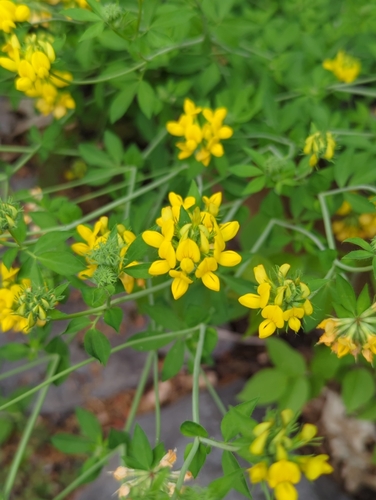
greater bird's-foot-trefoil
Lotus pedunculatus
A golden beacon of the marshlands, the greater bird's-foot-trefoil is a vital wetland survivor. Its hollow stems and nitrogen-fixing roots support a buzzing world of butterflies and bees.
Quick Identification
Size
Stems reach 30–100 cm (12–39 in) in length; flower heads are approximately 10–15 mm (0.4–0.6 in) wide.
Colors
Bright golden-yellow flowers often veined with red or orange; dark green foliage.
Key Features
- Hollow stems that are often slightly hairy
- Flower heads containing 5 to 15 individual pea-like blooms
- Trifoliate leaves with two additional leaf-like stipules at the base
- Sprawling or climbing growth habit in wet soil
When You’ll See Them
Geographic range
Where Does the greater bird's-foot-trefoil Live?
Native to a broad swathe of Europe, North Africa, and Western Asia, the greater bird's-foot-trefoil is a master of temperate wetland environments. It has been widely introduced and naturalized in North America, New Zealand, and Australia, where it is often utilized in permanent pastures. In its native range, it remains a signature species of traditional damp grasslands and undisturbed marshy verges.
Basemap © OpenStreetMap contributors
Behavior
In the ecosystem, this plant acts as a vital nitrogen fixer. Through a symbiotic relationship with Rhizobium bacteria in its root nodules, it converts atmospheric nitrogen into a form that enriches the surrounding soil. This makes it an essential 'nursery' plant in damp meadows, facilitating the growth of diverse plant communities. During the day, its flowers serve as a high-traffic hub for long-tongued insects, particularly bumblebees and the Common Blue butterfly.
EverydayEarth exclusive
Camera Tips
The best time for photography is during the height of summer, from June to August, when the plant is in full bloom. Use a 'Macro' or 'Close-Up' setting if your camera supports it, as the intricate red veining on the yellow petals is a fantastic diagnostic feature. Bright, overcast days are actually better than direct midday sun, as the soft light prevents the bright yellow flowers from appearing 'blown out' or overexposed in your images.
If you want to capture more than just a static image, set your camera to a high-sensitivity motion trigger or a short-interval time-lapse. This species is the primary food plant for the larvae of the Common Blue butterfly and a preferred nectar source for many bees. By focusing on a healthy cluster of flowers between 10 AM and 2 PM, you are highly likely to record a variety of winged visitors. For those looking for long-term data, a photo taken once a day from May to September will beautifully document the plant's sprawling growth and eventual seed pod development—the 'bird's foot' for which it is named.
Frequently Asked Questions
Record greater bird's-foot-trefoil at your habitat
Connect a camera to start building your own species record — AI identifies every visitor automatically.