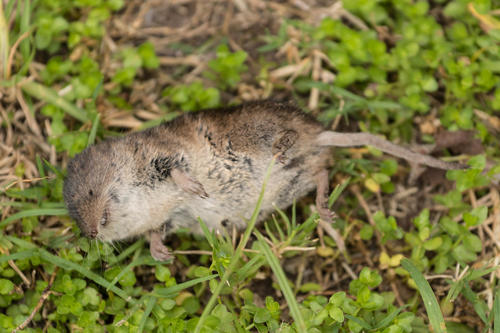
Greater Red Musk Shrew
Crocidura flavescens
A tiny but formidable predator of the African night, the Greater Red Musk Shrew is a master of the undergrowth. With its twitching snout and velvety coat, this territorial hunter is a common, though often unseen, guardian of Southern African gardens.
Quick Identification
Size
Total length including tail is 14–23 cm (5.5–9 inches); weighs between 30–55 grams (1–2 ounces).
Colors
Soft, velvety fur ranging from pale fawn to a distinct reddish-brown on the upper parts, with a lighter silvery-grey or buff-colored belly.
Key Features
- Long, tapered snout with highly sensitive whiskers
- Prominent rounded ears that are clearly visible through the fur
- Lateral musk glands on the flanks used for territorial scent marking
When You’ll See Them
Geographic range
Where Does the Greater Red Musk Shrew Live?
This small but hardy mammal is native to the southern tip of the African continent. Its core range is concentrated within the borders of South Africa, Lesotho, and Eswatini, while also stretching into the southern regions of Mozambique. It is a specialist of well-watered landscapes, thriving in coastal provinces and high-altitude grasslands where moisture supports a high density of invertebrate prey.
Basemap © OpenStreetMap contributors
Behavior
The Greater Red Musk Shrew is a solitary and fiercely territorial creature that operates under the cover of darkness. Unlike many small mammals that seek safety in numbers, these shrews prefer to roam alone, using potent secretions from their musk glands to mark their boundaries and warn off rivals. Males are particularly known for their high levels of aggression toward intruders, a trait that often intensifies when local population densities increase in resource-rich areas.
Because they have an incredibly high metabolic rate, these shrews are almost constantly on the move during their waking hours. They navigate their environment using a combination of a keen sense of smell and their sensitive whiskers, darting between patches of cover with quick, nervous movements. While they are generally asocial, they are remarkably adaptable to human environments, often taking up residence in suburban gardens where food and shelter are plentiful.
EverydayEarth exclusive
Camera Tips
To successfully capture the Greater Red Musk Shrew on camera, you need to think small and low. These animals rarely venture into the open, preferring to stick to 'micro-trails'—the narrow, hidden paths through thick mulch, leaf litter, or along the base of garden walls. Position your camera just 10–15 centimeters (4–6 inches) above the ground and angle it slightly downward. Because of their tiny size, a camera with a short focal length or macro capability will produce much clearer images than a standard trail cam designed for deer or larger mammals.
Baiting is the secret to getting a clear shot. Use high-protein lures like wet cat food, mealworms, or even a small smear of peanut butter on a rock directly in the camera's field of view. Their acute sense of smell will lead them to the bait quickly. Since they move with lightning-fast, jerky motions, set your camera to take bursts of 3–5 photos or short video clips to ensure you get a usable image. Ensure your PIR (passive infrared) sensor sensitivity is set to 'High' to detect their small body heat signature.
The best locations for placement are near compost heaps, woodpiles, or densely planted flower beds where moisture is retained. These areas are natural larders for shrews. If you are using an AI-powered camera, be aware that their rapid movement can sometimes trigger a recording just as they are leaving the frame, so wide-angle lenses are generally better for capturing the full animal. While they are active year-round, you will see the most activity during the warmer, wetter months when insects are most abundant.
Frequently Asked Questions
Record Greater Red Musk Shrew at your habitat
Connect a camera to start building your own species record — AI identifies every visitor automatically.