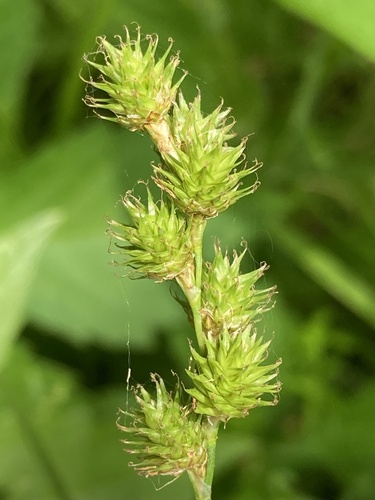
Greater Straw Sedge
Carex normalis
An elegant, clump-forming sedge known for its distinct straw-colored seed heads and exceptional value to local pollinators and songbirds. This hardy perennial is a staple of the North American moist prairie.
Quick Identification
Size
30-90 cm (12-36 inches) tall with a spread of approximately 30-45 cm (12-18 inches)
Colors
Bright green foliage; seed heads (perigynia) transition from light green to a distinct straw-yellow or tan as they mature.
Key Features
- Distinctly winged perigynia (seed casings) that are translucent at the edges
- Clusters of 4-10 flower spikes per stem
- Sharp, triangular stems typical of the Carex genus
- Clump-forming (caespitose) growth habit without aggressive runners
When You’ll See Them
Geographic range
Where Does the Greater Straw Sedge Live?
The Greater Straw Sedge is a quintessential North American species, with a native range that blankets the Eastern and Central United States and parts of Southeastern Canada. It is most densely populated from the Great Lakes region through the Ohio River Valley and into the Northeast. While it is primarily a continental resident, its adaptable nature allows it to thrive in various climates across the temperate zones of North America.
Basemap © OpenStreetMap contributors
Behavior
Greater Straw Sedge is a cool-season perennial that provides vital structure to wetland and meadow ecosystems. It begins its growth cycle in early spring, producing lush, green clumps that offer nesting material and cover for ground-dwelling wildlife. Unlike many invasive grasses, this sedge grows in tidy, non-aggressive bunches, making it a favorite for naturalistic landscaping and rain gardens.
While it may appear stationary, the Greater Straw Sedge is highly responsive to its environment, leaning its heavy, seed-laden stems toward the light as the season progresses. It plays a critical role as a larval host plant for several species of caterpillars, including various skippers and satyr butterflies. By mid-to-late summer, the plant focuses its energy on seed production, eventually turning a beautiful golden-tan color that persists into the winter months.
EverydayEarth exclusive
Camera Tips
Capturing the Greater Straw Sedge on an AI-powered camera requires a shift from motion-based triggers to time-lapse or high-clarity still captures. Because the plant moves frequently in the wind, standard motion sensors may trigger false alerts. To avoid this, set your camera to a 'Time-Lapse' mode with intervals of 1-2 hours to witness the fascinating progression from spring green-up to summer flowering and autumn seed dispersal.
For the most detailed identification shots, place your camera on a low-profile ground mount or a short tripod, roughly 15 inches from the ground. Angle the lens slightly upward to capture the unique 'winged' shape of the perigynia against the sky. This silhouette helps AI models distinguish Carex normalis from look-alike grasses. If you are using an AI camera to track wildlife, position it near a large clump of this sedge; many small mammals and birds like the Swamp Sparrow frequent these plants to forage for seeds.
Lighting is your best friend when photographing this species. The straw-colored seed heads are most vibrant during the 'Golden Hour' (the hour after sunrise or before sunset). Side-lighting during these times highlights the texture and transparency of the seed scales. During the winter, keep the camera active as the dried, tan stems provide excellent visual contrast against the snow, creating high-quality habitat photos even when the plant is dormant.
Frequently Asked Questions
Record Greater Straw Sedge at your habitat
Connect a camera to start building your own species record — AI identifies every visitor automatically.