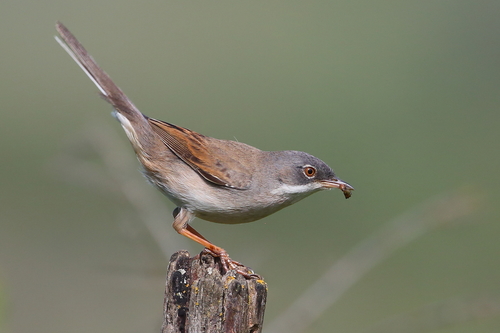
Greater Whitethroat
Curruca communis
A lively visitor with a distinctive 'scratchy' song and a bright white throat, this migratory warbler is a star of the summer scrubland. Watch for its energetic song flights and its preference for nesting in wild, brambly corners of the garden.
Quick Identification
Size
Length: 13–15 cm (5.1–5.9 in); Wingspan: 18–23 cm (7–9 in); Weight: 12–18 g (0.4–0.6 oz)
Colors
Male has a soft grey head, white throat, and a pinkish wash on the breast; wings show prominent rusty-brown or cinnamon edges. Females are duller with a brown head and buff throat.
Key Features
- Bright white throat patch contrasting with a grey or brown head
- Rusty-red or cinnamon-colored edges on the wing feathers (tertials)
- Long, dark tail with conspicuous white outer feathers
- Active, restless movement with frequent tail-flicking
When You’ll See Them
Geographic range
Where Does the Greater Whitethroat Live?
This resilient traveler is native to a vast stretch of the Old World, breeding across almost the entirety of Europe and extending into temperate Western Asia and North Africa. During the summer months, they are a staple of the countryside in the United Kingdom, France, and Germany, reaching as far east as Kazakhstan and western Siberia. As autumn approaches, the entire population embarks on a massive migration to wintering grounds in tropical Africa, particularly the Sahel region south of the Sahara, as well as parts of Arabia and Pakistan.
Basemap © OpenStreetMap contributors
Behavior
The Greater Whitethroat is a spirited and energetic warbler, known for its restless nature and distinctive scratchy song. During the breeding season, males are remarkably conspicuous as they perform 'song flights,' where they fly up from a perch into the air and flutter back down while singing. They are primarily birds of the scrub, preferring to stay within the protection of dense vegetation, though they often pop up to the highest twig of a bush to survey their territory.
While they are not traditionally 'tame' birds, they are quite bold when defending their territory or foraging. They spend much of their time gleaning insects from the undersides of leaves and in the depths of bramble thickets. As autumn approaches, their behavior shifts from territorial to focused on 'fattening up,' often joining small mixed groups of warblers to feed on ripening berries before their massive migratory journey across the Sahara.
EverydayEarth exclusive
Camera Tips
Capturing the Greater Whitethroat on camera requires a focus on 'perch points' rather than traditional bird feeders. These warblers rarely visit hanging seed or suet feeders, but they are highly attracted to water features and natural foraging spots. Position your camera about 2 to 3 feet off the ground, aiming it at a prominent, bare twig or 'song post' near a dense bramble patch or thick hedge. Because they are fast-moving, use a camera with a fast trigger speed (under 0.5 seconds) to avoid capturing empty branches.
Water is your best attractant for this species. A ground-level bird bath or a solar-powered dripper placed near thick cover is irresistible to Whitethroats, especially during the dry summer months or during their autumn migration window. Place the camera 4-6 feet away from the water source to ensure the bird fills the frame while remaining in focus. Early morning light provides the best results, as males are most active and vocal shortly after sunrise.
In late summer (August and September), move your camera to face fruiting bushes like elderberry, blackberry, or hawthorn. The birds become much more focused on feeding during this time and will linger longer on a branch while picking berries. Ensure your camera's PIR sensor is set to high sensitivity, as these small birds might not trigger a low-sensitivity setting. If your camera supports video, 15-second clips are better than stills for capturing their characteristic tail-flicking and energetic foraging style.
Similar Species
Species that look similar or are commonly confused with Greater Whitethroat.
Frequently Asked Questions
Record Greater Whitethroat at your habitat
Connect a camera to start building your own species record — AI identifies every visitor automatically.