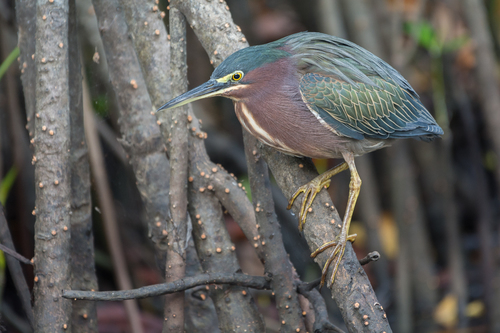
Green Heron
Butorides virescens
A master of patience and one of the few birds to use tools, the Green Heron is a secretive but stunning gem of the wetlands. Watch for its signature 'bait-fishing' technique as it stalks prey along the water's edge.
Quick Identification
Size
Length: 16–18 in (41–46 cm); Wingspan: 25–27 in (64–68 cm); Weight: 8.5 oz (240 g)
Colors
Deep velvet-green back and crown, rich chestnut-colored neck, white line down the throat, and yellow or orange legs
Key Features
- Small, stocky silhouette with a relatively short neck
- Long, dagger-like dark bill
- Distinctive iridescent green-black cap
- Crouched, horizontal hunting posture
When You’ll See Them
Sightings on EverydayEarth
Jun 21, 2026
Two Green Heron chicks are seen in their nest tucked away in the foliage. One chick is highly active, stretching its neck and opening its bill wide in a begging posture, while another chick stands tall nearby. A portion of an adult bird is also visible in the bottom-left corner.
Jun 10, 2026
A Green Heron is perched quietly among the branches of a tree, nearly motionless until it turns its head near the end of the clip. A misting system is active in the background, creating a soft, hazy atmosphere as sunlight filters through the green canopy.
Jun 7, 2026
Several American Alligators are basking on a sunny bank and resting in the shallow water of the swamp. In the lower right foreground, a Green Heron is perched among the leafy branches, remaining still as it scans the water's edge for prey.
Jun 5, 2026
A juvenile Green Heron is perched on a branch among green leaves. It remains mostly still, looking around its environment and blinking, with its neck feathers slightly ruffled.
Geographic range
Where Does the Green Heron Live?
The Green Heron is native to North and Central America, with a range extending from southern Canada and across the United States into Mexico and Panama. While northern populations are migratory and travel south for the winter, birds living along the Gulf Coast, Florida, and throughout the Caribbean and Central America are typically year-round residents. This adaptable species is common in both remote wilderness wetlands and developed suburban waterways across the continent.
Basemap © OpenStreetMap contributors
Behavior
Green Herons are solitary and famously secretive hunters. Unlike the larger, more conspicuous Great Blue Herons, they prefer to stay tucked away in dense vegetation along the water's edge, often standing motionless for long periods. They are one of the few bird species known to use tools; they frequently drop insects, feathers, or twigs onto the water's surface to lure fish within striking distance.
When startled, they often fly away with a sharp 'skeow' call, sometimes raising their shaggy crest in alarm. While they are usually quiet, their patient, crouched hunting posture makes them a fascinating subject for observation. They are generally tolerant of humans if given space, making them frequent visitors to backyard ponds and urban park lakes.
EverydayEarth exclusive
Camera Tips
To capture the best footage of a Green Heron, focus your camera on the 'strike zone'—the precise spot where the land meets the water. These birds are ambush predators that prefer to hunt from low-hanging branches, docks, or the muddy edge of a pond rather than wading in deep water. Mount your camera low to the ground (about 12-18 inches high) and angle it slightly upward to catch their intense facial expressions and the moment they lunge for prey.
Since Green Herons are master tool-users, try placing your camera near a calm patch of water where you can see the surface. They are most active during the 'golden hours' of dawn and dusk, so ensure your camera has a high-quality sensor for low-light conditions. Because they are shy and move with extreme caution, use a camera with a fast trigger speed; they can remain perfectly still for minutes before a lightning-fast strike that lasts only a fraction of a second.
If you have a backyard pond, you don't necessarily need bait, but providing a stable 'fishing perch' like a submerged log or a flat rock near the water's edge will significantly increase your chances of a sighting. These birds are creatures of habit and will return to the same successful hunting spot day after day. Ensure your PIR (motion) sensor sensitivity is set to high, as their slow, stalking movements might not always trigger a less sensitive device.
Similar Species
Species that look similar or are commonly confused with Green Heron.
Frequently Asked Questions
Record Green Heron at your habitat
Connect a camera to start building your own species record — AI identifies every visitor automatically.