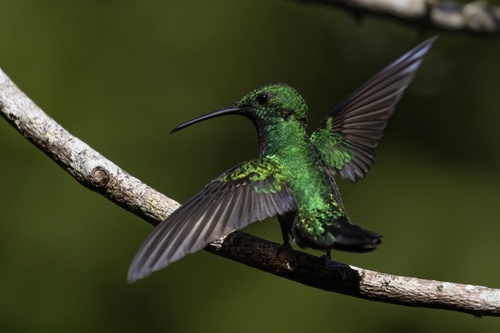
Green Mango
Anthracothorax viridis
An emerald gem found only in Puerto Rico, the Green Mango is a large, shimmering hummingbird that brings a flash of metallic brilliance to the island's mountain forests and coffee groves.
Quick Identification
Size
11–14 cm (4.3–5.5 in) in length; weight approximately 8.5–10 g (0.3–0.35 oz)
Colors
Uniform shimmering emerald green body with a metallic luster; dark bluish-black tail with a slight violet or copper sheen
Key Features
- Entirely green plumage with no white or red markings
- Large, robust body for a hummingbird
- Long, distinctly down-curved black bill
- Square-tipped tail with dark metallic tones
When You’ll See Them
Geographic range
Where Does the Green Mango Live?
The Green Mango is a Caribbean treasure found exclusively on the main island of Puerto Rico. As a true island endemic, its entire global population is concentrated within this tropical territory, thriving particularly in the lush mountainous interior and the coffee-growing regions of the Cordillera Central. While it can occasionally be seen at lower elevations, it is most abundant in the humid, high-altitude forests and shaded plantations across the island's central and western reaches.
Basemap © OpenStreetMap contributors
Behavior
The Green Mango is a bold and highly territorial hummingbird known for its vigorous defense of nectar-rich flowers. Unlike many smaller, flighty hummingbird species, the Green Mango often perches in plain sight on high, exposed branches between feeding bouts, keeping a watchful eye on its territory. It is a frequent visitor to coffee plantations and forest edges, where its iridescent green feathers provide surprisingly effective camouflage against the tropical foliage.
While they are primarily solitary foragers, they exhibit a sophisticated 'traplining' behavior, memorizing the locations of specific flowering plants and visiting them in a routine circuit throughout the day. They are remarkably adapted to human-altered landscapes, often becoming quite habituated to residents in rural and suburban Puerto Rican gardens, provided there are sufficient food sources and nesting sites available.
EverydayEarth exclusive
Camera Tips
To capture the stunning iridescent green of the Green Mango, positioning your AI-powered camera near large, sturdy tubular flowers like Heliconia or Hibiscus is essential. Since this species is larger than most hummingbirds, it tends to favor flowers that can support its weight or allow for a stable hover. Mount your camera at eye level (about 4 to 5 feet) facing a sunny patch of flowers, but ensure the sun is behind the camera to fully illuminate the metallic sheen of the bird's feathers.
High shutter speeds or a dedicated 'Action' mode are critical for capturing this bird without motion blur. Because the Green Mango is highly territorial, it will often return to the same 'sentinel branch' or perch to rest between feedings. If you can identify this branch, set your camera's focus point there; you are much more likely to get a crystal-clear, high-resolution image of the bird while it is stationary than when it is darting between flowers.
If using a nectar feeder to attract them, place it in a semi-shaded area to prevent the nectar from fermenting in the tropical heat, but ensure there is a clear, bright path for the camera sensor to detect motion. These birds are most active in the early morning and late afternoon. During the Caribbean rainy season, keep your camera ready for the 'golden hour' immediately following a rain shower, as Green Mangos will often feed voraciously to make up for time lost during the downpour.
Frequently Asked Questions
Record Green Mango at your habitat
Connect a camera to start building your own species record — AI identifies every visitor automatically.