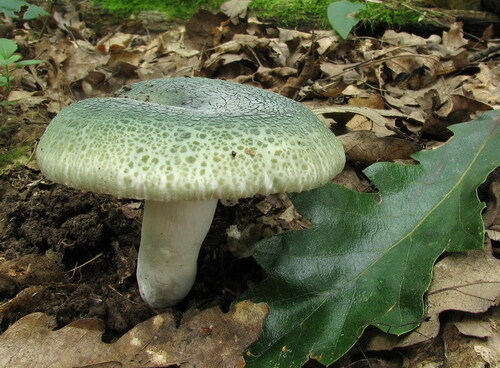
Green Russula
Russula virescens
With its stunning quilted pattern and sea-foam hues, the Green Russula is a jewel of the forest floor. This 'green-cracked' beauty tells a story of hidden connections between fungi and the towering trees above.
Quick Identification
Size
Cap diameter of 5–15 cm (2–6 in); stem height of 4–8 cm (1.5–3 in) and thickness of 2–4 cm (0.8–1.6 in).
Colors
Pale to sea-green cap surface with darker green angular patches (quilted pattern); pure white gills and stem.
Key Features
- Distinctive green 'quilted' or cracked cap texture
- Brittle white gills that do not bleed or bruise
- Sturdy white stem without a ring or veil
- Flesh that breaks cleanly like a piece of chalk
When You’ll See Them
Loading activity data...
Behavior
The Green Russula is a fascinating member of the fungal kingdom that spends most of its life hidden underground as a network of mycelium. Unlike animals, it doesn't 'behave' in a traditional sense, but it forms a vital, sophisticated symbiotic relationship with the roots of hardwood trees, particularly oaks and beeches. This mycorrhizal connection allows the mushroom to swap minerals and water for sugars produced by the tree through photosynthesis.
When conditions are just right—typically following a period of summer rain—the fungus sends up its fruiting body, the mushroom we see above ground. These mushrooms appear individually or in small scattered groups. To humans and wildlife alike, they are a sign of a healthy, mature forest ecosystem. Because they are stationary and lack the 'flight' response of animals, they are excellent subjects for observation, though they are often nibbled on by squirrels, slugs, and woodland rodents shortly after emerging.
EverydayEarth exclusive
Camera Tips
To capture the stunning 'quilted' detail of the Green Russula, you need to think low. Place your camera on a ground-level mount or a small beanbag within a few inches of the forest floor. Angle the lens slightly upward to catch the transition between the textured green cap and the brilliant white gills underneath. If your camera has a macro mode, this is the time to use it, as the intricate cracking pattern on the cap is the species' most photogenic feature.
While traditional trail cameras are often triggered by motion, the Green Russula is a perfect candidate for time-lapse photography. Set your camera to take a photo every 30 to 60 minutes over a 48-hour period starting just after a heavy summer rain. This allows you to document the 'magic' of the mushroom as it pushes through the leaf litter and expands its cap—a process that is surprisingly dynamic when sped up.
Lighting is your biggest challenge in the shaded woods where these mushrooms grow. Avoid using a direct, harsh flash, which can wash out the subtle greens and whites. Instead, try to position the camera during the 'golden hours' or use a small, portable LED light with a diffuser to mimic soft, dappled sunlight. This will help highlight the velvety texture of the green patches against the paler skin of the cap.
Since these mushrooms don't move, you can also use them as a 'bait' of sorts for other wildlife. Position a secondary camera a few feet away to catch squirrels or chipmunks that might stop by to snack on the cap. This 'set-and-forget' method often yields candid shots of small mammals that you might otherwise miss. Ensure your camera is well-camouflaged with leaf litter to prevent it from being disturbed by curious animals or hikers.
Similar Species
Species that look similar or are commonly confused with Green Russula.
Frequently Asked Questions
Record Green Russula at your habitat
Connect a camera to start building your own species record — AI identifies every visitor automatically.