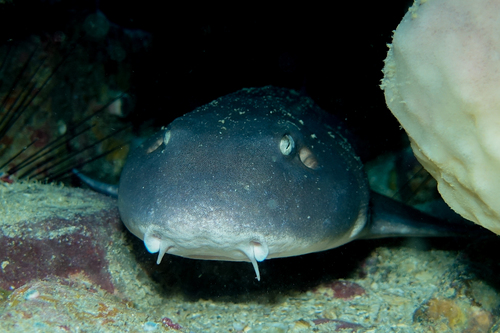
Grey Bamboo Shark
Chiloscyllium griseum
The Grey Bamboo Shark is a graceful, bottom-dwelling resident of the Indo-Pacific's coral reefs. Known for its 'walking' fins and docile nature, this nocturnal predator is a master of blending into the sandy seafloor.
Quick Identification
Size
Grows to a maximum length of approximately 74 cm (29 inches)
Colors
Adults are a uniform plain grey or light brown; juveniles feature dark transverse bands that fade as they reach maturity.
Key Features
- Slender, cylindrical body shape
- Two dorsal fins of nearly equal size
- Rounded snout with short barbels near the mouth
- Thick, muscular pectoral fins used for 'walking' on the seafloor
When You’ll See Them
Geographic range
Where Does the Grey Bamboo Shark Live?
Native to the tropical Indo-West Pacific, the Grey Bamboo Shark is a coastal specialist found from the Arabian Sea across to the shores of Papua New Guinea. Its core range includes the waters of India, Thailand, Malaysia, and Indonesia, extending northward to China and the southern islands of Japan. While they are strictly marine and have no introduced populations, they are frequently sighted in the shallow, intertidal zones of these regions.
Basemap © OpenStreetMap contributors
Behavior
The Grey Bamboo Shark is a slow-moving, bottom-dwelling species that spends much of its day resting in the crevices of coral reefs or under rocky ledges. Unlike many larger shark species that must swim constantly to breathe, this 'carpet shark' can remain stationary, using its specialized gills to pump water while it rests. It is a docile and non-aggressive creature that poses no threat to humans, often ignoring divers and snorkelers as it blends into the substrate.
As a nocturnal hunter, it becomes most active after the sun sets. It uses a unique method of locomotion, using its flexible pectoral and pelvic fins to 'crawl' along the seabed rather than swimming through the water column. This allows it to navigate tight spaces within the reef where it searches for hidden prey. They are solitary animals, though multiple individuals may share a particularly high-quality shelter during daylight hours.
EverydayEarth exclusive
Camera Tips
To capture high-quality footage of a Grey Bamboo Shark, you will need a dedicated underwater camera or a trail camera equipped with a high-pressure waterproof housing. For coastal 'backyards' like piers, docks, or private beachfronts, mount the camera on a weighted tripod or a heavy baseplate to prevent it from being moved by tides and currents. The camera should be positioned no more than 12 inches above the seafloor, as these sharks rarely swim high into the water column.
Attracting this species requires a scent-based lure. Place a perforated PVC pipe or a mesh bag filled with oily fish scraps (like mackerel or sardines) approximately three to five feet in front of the lens. The Grey Bamboo Shark has an extraordinary sense of smell and will follow the scent trail directly to your camera. Because they are nocturnal, a camera with powerful infrared (IR) LEDs or a low-intensity, wide-angle underwater light is essential. Avoid using overly bright white lights, which can cause 'washout' on their reflective skin or startle the shark away.
Timing is critical; the best results usually occur during a rising tide at night, when these sharks move into shallower waters to forage. Set your camera to record 30-second video clips with a short trigger interval. If your camera has a 'time-lapse' mode, consider setting it to take a photo every 30 seconds throughout the night; this is often more reliable than motion sensors, which can be triggered by swaying seaweed or floating debris. Check the lens for algae growth or salt buildup every few days to ensure crystal-clear imagery.
Frequently Asked Questions
Record Grey Bamboo Shark at your habitat
Connect a camera to start building your own species record — AI identifies every visitor automatically.