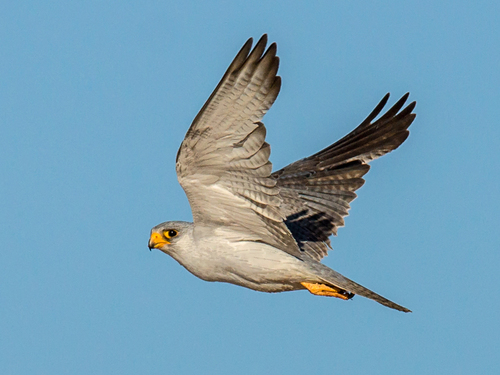
Grey Falcon
Falco hypoleucos
Meet the 'Ghost of the Desert,' Australia's rarest and most elusive falcon. With its striking pale plumage and incredible speed, seeing a Grey Falcon is a bucket-list event for birders worldwide.
Quick Identification
Size
Length: 33–45 cm (13–18 in); Wingspan: 84–97 cm (33–38 in); Weight: 330–600 g (0.7–1.3 lbs)
Colors
Uniform pale grey upperparts, white to light grey underparts, blackish wing tips, with striking yellow cere, eye-ring, and feet
Key Features
- Ghostly pale grey plumage with dark wingtips
- Bright yellow fleshy parts around eyes and beak
- Long, pointed wings and a relatively short tail
- Powerful, stocky build compared to other falcons
When You’ll See Them
Geographic range
Where Does the Grey Falcon Live?
Native to the continent of Australia, the Grey Falcon is one of the most geographically restricted raptors in the world. Its core range is centered in the arid Lake Eyre Basin and the Murray-Darling Basin, though it occasionally wanders into the semi-arid fringes of every mainland state. It is entirely absent from Tasmania and the most humid coastal forests, thriving instead in the harshest, driest hearts of the Outback where permanent water is scarce.
Basemap © OpenStreetMap contributors
Behavior
The Grey Falcon is often referred to as the 'ghost of the desert' due to its elusive nature and pale, ethereal plumage. Unlike many other raptors that soar high in the thermals, this species often hunts with a low, stealthy approach, using high-speed level flight to surprise prey. They are largely solitary or found in breeding pairs, maintaining large territories in the vast, arid interior of Australia. Because they live in such unpredictable environments, they are highly nomadic, moving hundreds of miles to follow localized rainfall and the subsequent explosions of bird populations.
Interaction with humans is extremely rare, as they prefer the most remote regions of the Outback. They are not particularly aggressive but are incredibly wary, often perching high in River Red Gums along ephemeral watercourses where they can survey the landscape for miles. During the breeding season, they do not build their own nests, instead refurbishing the abandoned stick nests of crows or other raptors located in the tallest available trees.
EverydayEarth exclusive
Camera Tips
Capturing the rare Grey Falcon on camera is a significant achievement for any wildlife enthusiast. Given their nomadic nature and preference for arid regions, your best strategy is to focus on water. In the dry interior, 'bores' (artificial water troughs) and isolated cattle tanks are magnets for the birds they prey upon. Position your camera on a sturdy post overlooking a water source at a height of 1.5 to 2 metres, angling it slightly downward to capture both the water's edge and the surrounding perches.
Because these falcons are lightning-fast, you must use a camera with a high-speed trigger and a fast shutter speed setting if available. AI-powered cameras should be set to 'Bird' or 'Raptor' priority modes. To increase your chances, look for the tallest trees in an otherwise flat landscape—River Red Gums are favorites. Mounting a camera high in a tree facing a known nesting site (from a respectful distance of at least 50 metres) can provide incredible footage during the breeding months of July to October.
Avoid using traditional lures or baits, as these can attract unwanted predators like feral cats to sensitive areas. Instead, rely on the natural draw of water and high-view perches. If you are using a trail camera, ensure it has a high-resolution video mode, as the subtle grey plumage of the falcon can sometimes blend into a bright sky in still photos. Early morning light is your best friend here, as the golden hour highlights the yellow cere and eye-rings that distinguish this species from the more common Peregrine Falcon.
Similar Species
Species that look similar or are commonly confused with Grey Falcon.
Peregrine Falcon
Much darker head with a distinct black 'hood' and heavily barred underparts compared to the Grey's uniform pale plumage.
Black Falcon
Similar in shape but significantly darker, appearing almost sooty black or dark brown, whereas the Grey Falcon is light silver-grey.
Grey Goshawk
Has shorter, rounded wings and a much longer tail; it is a forest dweller, unlike the open-country Grey Falcon.
Frequently Asked Questions
Record Grey Falcon at your habitat
Connect a camera to start building your own species record — AI identifies every visitor automatically.