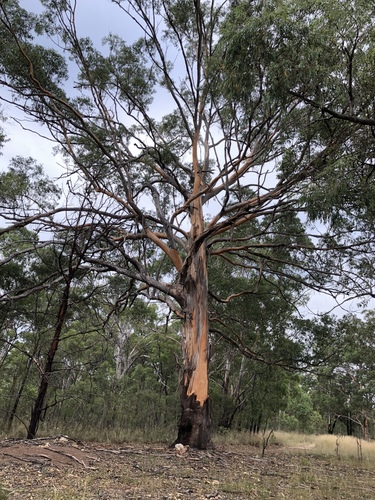
Grey Gum
Eucalyptus punctata
A cornerstone of the Australian bush, the Grey Gum is famous for its mosaic-patterned bark and its status as a five-star restaurant for local koalas.
Quick Identification
Size
Height ranging from 10 to 35 metres (33 to 115 feet); trunk diameter up to 1 metre (3.3 feet)
Colors
Bark features patches of grey, white, cream, and dull orange; adult leaves are dark green on top and significantly paler underneath
Key Features
- Smooth, matte bark that sheds in irregular large patches
- Discolorous leaves with a dark upper surface and pale underside
- Flower buds arranged in groups of seven
- Hemispherical or cup-shaped woody fruit 5-9mm long
When You’ll See Them
Geographic range
Where Does the Grey Gum Live?
Native to the Oceania continent, the Grey Gum is found exclusively along the eastern coast of Australia. Its core range is concentrated within the state of New South Wales, stretching from the Jervis Bay region in the south up to the Hunter Valley in the north. It is a signature species of the Sydney Basin, where it thrives in the rugged, sandstone-derived landscapes common to the coastal ranges and inland slopes.
Basemap © OpenStreetMap contributors
Behavior
The Grey Gum is a steady, long-lived hardwood that defines the dry sclerophyll forests of eastern Australia. Unlike animals, its 'behavior' is observed through its seasonal cycles; it is a decorticating species, meaning it sheds its bark annually in large, irregular flakes. This shedding process reveals a fresh, colorful mosaic of creams and oranges beneath the weathered grey exterior, which gradually fades back to a matte grey over the year.
As a vital 'home' tree, it interacts deeply with local fauna. It is one of the most important primary food trees for koalas, who prefer the high-moisture, nutrient-dense leaves of this specific species. During its flowering period, which typically occurs between summer and early autumn, the tree becomes a hub of social activity for honeyeaters, gliders, and various pollinating insects attracted to its white blossoms.
EverydayEarth exclusive
Camera Tips
To capture the true essence of a Grey Gum, position your camera to focus on the trunk at a height of 2 to 3 metres. This is the 'highway' for arboreal mammals like koalas and sugar gliders. Use a wide-angle lens if you want to capture the stunning patchwork of the bark, which is most vibrant immediately after rain when the oranges and creams pop against the wet grey scales. A side-on angle works best to capture animals climbing without them obscuring the camera lens.
If you are targeting koalas, look for 'scratches' or 'pockmarks' on the bark, which indicate a frequently used tree. Set your camera to a fast trigger speed and burst mode, as koalas can move surprisingly quickly when transitioning between branches. For night captures, ensure your infrared flash is well-positioned; the smooth bark of the Grey Gum can be highly reflective, so angling the camera slightly downward or using a diffuser can prevent overexposed 'white-out' photos.
During the flowering season (December to March), consider placing a camera on a sturdy branch higher up in the canopy. This is the best way to document the diverse range of honeyeaters and lorikeets that visit the white flowers. Because the canopy moves in the wind, use a high shutter speed and adjust your PIR sensitivity to medium to avoid thousands of false triggers from swaying leaves.
Frequently Asked Questions
Record Grey Gum at your habitat
Connect a camera to start building your own species record — AI identifies every visitor automatically.