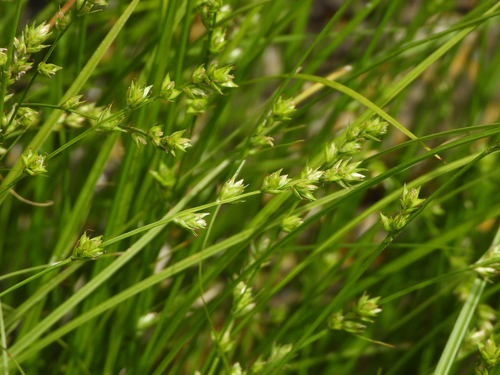
Grey Sedge
Carex divulsa
An elegant, fountain-like evergreen sedge, Grey Sedge provides year-round texture and essential habitat for backyard wildlife. Its hardy nature and unique 'interrupted' flower spikes make it a favorite for naturalized landscapes.
Quick Identification
Size
Grows 30–60 cm (12–24 inches) in height with a spread of 30–45 cm (12–18 inches).
Colors
Greyish-green foliage with brownish-green flower spikes that turn tan or straw-colored as they mature.
Key Features
- Clump-forming (caespitose) growth habit
- Slender, arching stems with a triangular cross-section
- Inflorescence with flower spikes widely spaced or 'interrupted' at the base
- Narrow, grass-like leaves with a distinct grey-green hue
When You’ll See Them
Behavior
Grey Sedge is a hardy, perennial evergreen that grows in dense, fountain-like clumps. Unlike many spreading grasses, it stays in a tidy 'tussock' formation, making it an excellent choice for stabilizing soil on banks or creating low-maintenance meadow transitions. It is known for its resilience, capable of thriving in both dappled shade and full sun, and resisting many common garden pests.
As a member of the Carex genus, it plays a vital role in the ecosystem by providing structural cover for ground-dwelling insects and small amphibians like toads. While it doesn't move like an animal, it 'behaves' through its seasonal growth cycles—sending up long, wiry flower stalks in late spring that eventually lean outward under the weight of their seeds, effectively expanding its footprint over time.
EverydayEarth exclusive
Camera Tips
Capturing the subtle beauty of Grey Sedge requires a focus on texture and lighting. To get the best results on a backyard or trail camera, mount your device at a low angle, roughly 6 to 12 inches off the ground. This 'bug’s-eye view' highlights the arching fountain shape of the leaves and makes it easier to spot small wildlife, such as beetles or frogs, that seek shelter within the clump. If you are using a camera with manual settings, aim for a wide aperture (low f-stop) to blur the background and make the fine, greyish-green blades pop against the surrounding garden.
Because the foliage is thin and prone to 'blowing out' in bright light, the best time to photograph Grey Sedge is during the 'Golden Hour'—just after sunrise or before sunset. The soft, directional light during these times emphasizes the grey-green color and the unique texture of the interrupted flower spikes. If your camera is motion-activated, be aware that wind can trigger 'false positives' due to the swaying stems; consider setting the sensitivity to medium and placing the camera at a 45-degree angle to the prevailing wind to capture the plant's movement without constant triggering.
For those interested in the ecological impact of the plant, set your camera to a time-lapse mode during the months of May and June. Taking one photo every 30 minutes during the day can reveal how the flower stalks emerge and bow over time. This is also a great way to document pollinators or small birds that may visit the plant to forage for seeds or nesting material. If using a flash at night, be mindful that the reflective surface of the leaves can cause glare; a side-mounted external light source can help create more depth and detail.
Frequently Asked Questions
Record Grey Sedge at your habitat
Connect a camera to start building your own species record — AI identifies every visitor automatically.