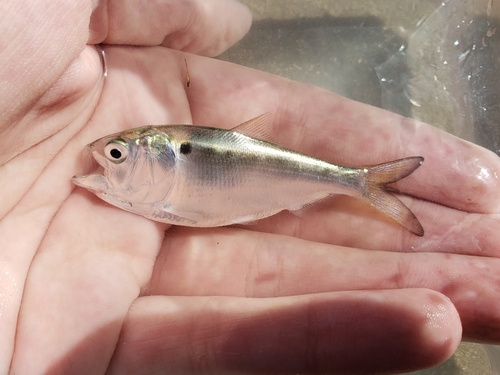
Gulf Menhaden
Brevoortia patronus
Often called 'the most important fish in the sea,' the Gulf Menhaden is a shimmering silver link in the marine food web, fueling the entire Gulf of Mexico ecosystem.
Quick Identification
Size
15-25 cm (6-10 inches) in length; 0.2-0.5 kg (0.5-1.1 lbs) in weight
Colors
Silvery with a greenish-blue back and brassy sides; features a prominent black spot behind the gill cover and several smaller, irregular spots behind it.
Key Features
- Deep, compressed body shape
- Single large black spot behind the operculum
- Strongly forked tail fin
- Jagged, serrated scales along the belly (scutes)
When You’ll See Them
Geographic range
Where Does the Gulf Menhaden Live?
Native to the North American coastline, the Gulf Menhaden is found exclusively within the Gulf of Mexico. Its range spans from the coastal waters of the Florida Panhandle, westward through the Mississippi Delta, and south along the Texas coast into the Mexican waters of the Yucatan Peninsula. They are most concentrated in the nutrient-dense brackish zones where major rivers meet the sea.
Basemap © OpenStreetMap contributors
Behavior
Gulf Menhaden are highly social, schooling fish that play a foundational role in the Gulf of Mexico's marine ecosystem. They move in massive, dense groups that can contain millions of individuals, swimming rhythmically to filter nutrients from the water column. These schools are often visible from the surface as "ripples" or "boils," attracting a wide variety of predators from above and below.
In terms of social patterns, these fish are largely migratory, moving into deep offshore waters during the winter and returning to nutrient-rich estuaries and nearshore environments in the spring. While they do not interact with humans directly in a pet-like or aggressive manner, they are the backbone of a massive commercial fishing industry that processes them into fish oil and meal. For coastal residents, they are a familiar sight near piers and in salt marshes.
EverydayEarth exclusive
Camera Tips
Capturing the Gulf Menhaden requires a specialized approach since they are entirely aquatic and do not take bait like traditional game fish. To see them on an AI-powered backyard or dock camera, you must use a waterproof submersible setup. Mount your camera 1 to 2 feet below the surface of the water on a stationary structure like a dock piling or a weighted tripod in a shallow estuary. Position the lens to face slightly upward toward the light; this helps capture the distinctive silvery flash of their sides as the school passes by.
Because Gulf Menhaden are filter feeders, standard lures won't work. However, they are often found in areas with high plankton concentrations. Look for 'pogey' schools rippling the water's surface on calm mornings. If your camera is near a light source at night, you may catch them as they are occasionally attracted to the periphery of dock lights where plankton accumulates, though they are primarily diurnal. Use a high frame rate (60 fps or higher) to capture the fluid, synchronized movement of the school without blurring.
Turbidity is your biggest challenge in the Gulf. For the best results, wait for a period of high tide or a day with offshore winds which tend to bring clearer water into the bays. Avoid placing the camera directly on the bottom where silt can be kicked up. Instead, use a mid-water mount. If your camera system supports AI triggers, set it to detect rapid movement or 'flashing,' as the reflective scales of a turning Menhaden school are its most visible feature under the waves.
Similar Species
Species that look similar or are commonly confused with Gulf Menhaden.
Frequently Asked Questions
Record Gulf Menhaden at your habitat
Connect a camera to start building your own species record — AI identifies every visitor automatically.