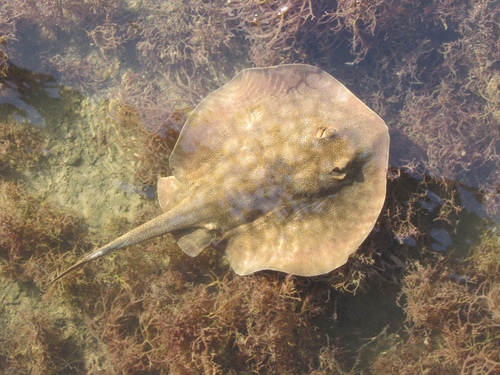
Haller's Round Ray
Urobatis halleri
A master of the 'stingray shuffle,' this circular seafloor dweller is the most common ray encountered along the sunny shores of the Pacific coast.
Quick Identification
Size
Disc width typically 25-30 cm (10-12 in); total length up to 58 cm (23 in); weight up to 1.5 kg (3.3 lbs)
Colors
Mottled brown, olive, or grayish-yellow upper disc with small dark spots or reticulations; underside is pale yellow or white
Key Features
- Nearly circular pectoral disc shape
- Robust tail shorter than the body disc
- Long, serrated venomous spine located midway down the tail
- Camouflaged mottled pattern with no dorsal fin
When You’ll See Them
Geographic range
Where Does the Haller's Round Ray Live?
The Haller's Round Ray is a quintessential resident of the Northeastern Pacific Ocean, primarily found along the coast from Point Conception in California down through the entire Baja California peninsula. Its range extends through the lush coastal waters of the Gulf of California and continues southward along the Central American coastline to Panama. This species is strictly coastal, favoring the warm, shallow shelf waters of the eastern Pacific over the open ocean.
Basemap © OpenStreetMap contributors
Behavior
Haller’s Round Rays are masters of coastal camouflage, spending much of their time partially buried in the sand or fine silt of the seafloor. By using their pectoral fins to scoop out a shallow depression and then waving sediment over their backs, they become almost invisible to both predators and unsuspecting prey. They breathe by drawing water through spiracles located behind their eyes, allowing them to remain submerged in the sand for extended periods without inhaling grit into their gills.
While generally solitary foragers, these rays are known to congregate in large numbers in warm-water areas, particularly near estuaries or power plant outfalls during the winter months. They are non-aggressive toward humans but possess a potent defensive mechanism: a venomous stinger on the tail. Most human injuries occur when a ray is accidentally stepped on in the surf, triggering a reflexive upward strike. This has led to the famous 'stingray shuffle' technique used by coastal residents to alert the rays of their presence.
EverydayEarth exclusive
Camera Tips
Capturing the Haller’s Round Ray requires an underwater setup, such as a waterproof action camera or a specialized marine trail camera. The best placement is in the intertidal zone or shallow bays during low tide; secure your camera to a weighted base or a sand-stake so it remains stable when the tide returns. Aim the lens at a slight downward angle toward a patch of open sand, as these rays prefer clear areas where they can easily bury themselves.
To guarantee a sighting, use a scent-based attractant. A mesh 'chum bag' filled with crushed mussels, frozen squid, or fish scraps is highly effective. Tether the bag roughly 18 to 24 inches in front of the lens. The rays will pick up the scent trail and congregate to investigate, often putting on a show as they 'flap' their pectoral fins against the sand to uncover the source of the smell.
Visibility is key for AI detection, so try to position your camera in areas with minimal surge or suspended silt. Early morning light provides the most natural color for their mottled patterns, while high tide usually brings the rays closer to shore. If your camera allows for high-frame-rate recording (60fps or higher), use it; while they often sit still, their 'flight' response when startled is incredibly fast and produces spectacular footage.
Be mindful of the tide cycles to ensure you can recover your gear. In Southern California and Mexico, look for 'hot spots' near river mouths or warm water outlets where these rays are known to huddle in large groups. Setting the camera to record 30-second clips upon motion trigger is usually better than time-lapse, as you’ll want to see the specific moment the ray unburies itself from the sand.
Similar Species
Species that look similar or are commonly confused with Haller's Round Ray.
Frequently Asked Questions
Record Haller's Round Ray at your habitat
Connect a camera to start building your own species record — AI identifies every visitor automatically.