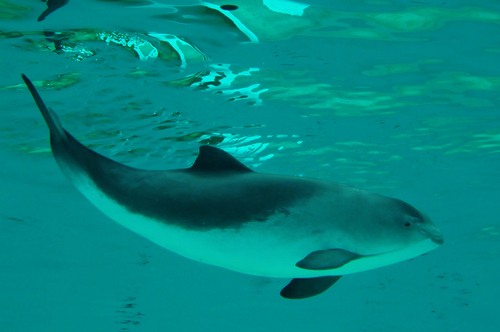
Harbour Porpoise
Phocoena phocoena
The Harbour Porpoise is the shy, 'puffing pig' of the coastal world, known for its small size and elusive nature. Often found in the very bays and estuaries we call home, this tiny cetacean is a master of the shallows.
Quick Identification
Size
1.4 to 1.9 metres (4.6 to 6.2 feet) in length; weighing between 60 and 75 kg (130 to 165 lbs)
Colors
Dark grey or nearly black on the back (dorsal side), fading to a lighter mottled grey on the flanks, and a stark white on the underside.
Key Features
- Small, triangular dorsal fin located at the center of the back
- Blunt, rounded head with no discernible beak or snout
- Stocky, robust body shape compared to streamlined dolphins
- Dark grey stripe extending from the corner of the mouth to the flippers
When You’ll See Them
Geographic range
Where Does the Harbour Porpoise Live?
The Harbour Porpoise is native to the cold-temperate and subarctic waters of the Northern Hemisphere. It maintains a vast range across the North Atlantic, stretching from the United States and Canada across to the United Kingdom, Norway, and down to West Africa, while a separate population inhabits the North Pacific from Japan to Alaska and down the California coast. Additionally, a distinct subspecies is found in the isolated waters of the Black Sea and the Sea of Azov, making it one of the most widely distributed small cetaceans in the world.
Basemap © OpenStreetMap contributors
Behavior
Harbour Porpoises are famously shy and elusive compared to their more boisterous dolphin cousins. Unlike dolphins, they rarely leap out of the water or 'bow-ride' alongside boats; instead, they are most often seen briefly as they break the surface in a gentle rolling motion to breathe. They are frequently solitary or found in small pods of two to three individuals, though larger aggregations may form temporarily in areas with abundant food sources.
These cetaceans are highly reliant on echolocation to navigate and hunt in murky coastal waters. They produce high-frequency clicks that are beyond the range of human hearing but can be detected with specialized hydrophones. Because of their small size and high metabolism, they must eat almost constantly—consuming up to 10% of their body weight every day—to maintain their body temperature in cold northern waters.
While they generally avoid human interaction, their preference for coastal habitats brings them into frequent contact with human activity. They are known to be sensitive to underwater noise and are often the first species to leave an area if there is significant industrial or boat traffic. In some regions, they are affectionately known as 'puffing pigs' because of the sneezing or chuffing sound they make when breathing at the surface.
EverydayEarth exclusive
Camera Tips
Capturing a Harbour Porpoise on a backyard or trail camera requires a unique approach, as these mammals never leave the water. If you live on a coastal property, a pier, or a cliffside, the best setup is to mount your camera on a high vantage point overlooking a narrow channel or a known feeding 'hotspot.' Because PIR (Passive Infrared) motion sensors do not work through water or over long distances, you must set your camera to 'Time Lapse' mode. A frequency of one photo every 5 to 10 seconds during daylight hours is ideal for catching a glimpse of their dark dorsal fins breaking the surface.
Standard trail cameras may struggle with the vast distance of the ocean, so look for models with a high-resolution sensor or 4K video capabilities to allow for cropping later. If you are using a camera with an optical zoom or a telephoto lens, focus on areas where current or tides create 'rips'—Harbour Porpoises love to hunt in these turbulent spots where fish become disoriented. Angle your camera downward to minimize the glare from the sun hitting the water, which can wash out the image and hide the porpoise's dark back.
Avoid trying to 'bait' porpoises; instead, monitor the local tide charts. These animals are most likely to move into shallow bays and estuaries on a rising tide to follow their prey. During the summer, when the water is calmer, you have a much better chance of getting a clear shot. In your settings, prioritize a high shutter speed if possible to freeze the motion of the water and the quick roll of the porpoise's back, which often lasts for only a second or two.
Similar Species
Species that look similar or are commonly confused with Harbour Porpoise.
Frequently Asked Questions
Record Harbour Porpoise at your habitat
Connect a camera to start building your own species record — AI identifies every visitor automatically.