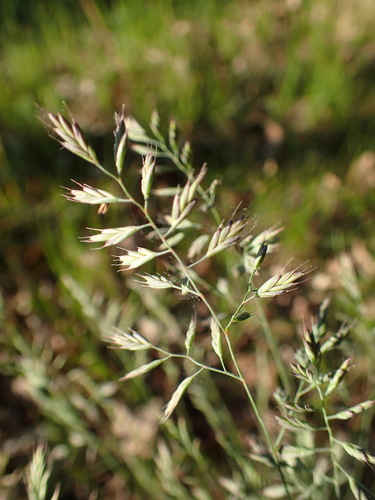
hard fescue
Festuca trachyphylla
The unsung hero of the low-maintenance backyard, hard fescue is a hardy, bunch-forming grass that thrives where others wither. Its fine-textured, blue-green blades provide a soft, meadow-like carpet that supports a hidden world of ground-dwelling wildlife.
Quick Identification
Size
Foliage height 6-12 inches (15-30 cm); seed heads up to 24 inches (60 cm)
Colors
Grayish-green to blue-green blades; tan or straw-colored seed heads in late summer
Key Features
- Densely tufted bunchgrass habit
- Fine, needle-like leaf texture
- Grayish-green or glaucous foliage tint
- Slow-growing and non-creeping
When You’ll See Them
Behavior
Hard fescue is a resilient, cool-season bunchgrass known for its 'well-behaved' nature in the landscape. Unlike many turfgrasses that spread aggressively via underground runners, hard fescue grows in tidy, dense clumps. It is remarkably patient, growing slowly and requiring far less water and fertilizer than traditional lawn species. Its deep root system allows it to remain green during moderate droughts when other grasses go dormant.
In a backyard ecosystem, hard fescue acts as a foundational species. It provides essential cover for ground-dwelling insects and small mammals. Because it thrives in the shade and poor soil, it often occupies the 'difficult' corners of a yard where other plants fail. Humans value it most for 'no-mow' or low-maintenance lawns, as it naturally flops over at a certain height to create a soft, meadow-like aesthetic.
EverydayEarth exclusive
Camera Tips
Capturing the subtle beauty of hard fescue on camera requires a focus on texture and light. To showcase the grass's fine, needle-like blades, set your camera at a low 'worm's eye' angle, roughly 4 to 6 inches off the ground. This perspective allows the AI to better distinguish the bunching habit of the fescue from flatter, broader-leaved weeds. Using a camera with a macro or close-up focus capability will highlight the morning dew clinging to the thin blades, which creates stunning visual content.
Time-lapse mode is the best way to 'watch' this species. Set your camera to take a photo every hour during the spring green-up (typically March or April). When played back, you’ll see the clumps expand and the flower stalks (panicles) shoot upward in a dramatic display of growth. For the best lighting, position your camera facing East or West to catch the 'golden hour' light, which catches the grayish-green tint of the blades and makes the seed heads glow.
Hard fescue is a magnet for small wildlife, making it an excellent 'stage' for your trail camera. Place your camera near a patch of fescue that has been left unmown. You are likely to capture footage of foraging songbirds picking at the seeds in late summer, or small mammals like rabbits and voles using the dense clumps for thermal cover. If you are targeting insects, use a high-frame-rate setting to capture the movement of pollinators visiting the tiny, inconspicuous flowers during the early summer bloom.
In winter, hard fescue provides structural interest even under a light dusting of snow. Keep your camera active during the colder months to see how the persistent clumps offer shelter to backyard birds during storms. Avoid placing the camera in areas with standing water, as hard fescue prefers well-drained spots and won't look its best (or survive long) in boggy conditions. High-contrast settings can help the fine blades stand out against a snowy or mulch-heavy background.
Similar Species
Species that look similar or are commonly confused with hard fescue.
Frequently Asked Questions
Record hard fescue at your habitat
Connect a camera to start building your own species record — AI identifies every visitor automatically.