Hard Rush
Juncus inflexus
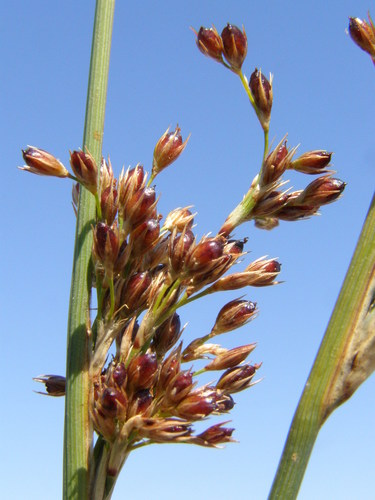
The Hard Rush is a striking, blue-hued sentinel of the wetlands, easily recognized by its stiff, ridged stems. A favorite of backyard pond enthusiasts, it provides critical structural habitat for amphibians and insects alike.
Quick Identification
Size
Grows 30–90 cm (12–36 inches) in height with a spread of 30–60 cm (12–24 inches).
Colors
Distinctive blue-grey to glaucous green stems with chestnut-brown or bronze flower clusters.
Key Features
- Deeply ridged, blue-green stems
- Clump-forming perennial growth habit
- Interrupted white pith inside stems
- Straw-colored to chestnut brown flower clusters
- Pointed bract that looks like a continuation of the stem
When You’ll See Them
Behavior
Hard Rush is a resilient, perennial wetland plant that grows in dense, stiff clumps known as tussocks. Unlike many other rushes that spread aggressively via long underground runners, Juncus inflexus tends to stay in localized, architectural mounds. It is a 'glycophyte,' meaning it thrives in non-saline environments, making it a common sight in freshwater ecosystems across its native and introduced ranges.
In the backyard ecosystem, Hard Rush acts as a foundational species for moisture-rich areas. It doesn't 'behave' in the animal sense, but its growth pattern provides significant structural complexity to a garden. It is famously tough and unpalatable to most livestock and deer, which allows it to thrive in areas where other vegetation might be overgrazed. Its stiff stems remain upright even through winter, providing year-round vertical interest and shelter for small organisms.
EverydayEarth exclusive
Camera Tips
When capturing Hard Rush on your backyard camera, the goal is to highlight its unique architectural texture and the wildlife it attracts. Position your camera on a low tripod or ground mount, about 12-18 inches off the floor. Angle the lens slightly upward to emphasize the verticality of the blue-green stems against the sky. Because the stems are highly textured with vertical ridges, early morning or late afternoon light (golden hour) is ideal; the side-lighting will cast small shadows in the grooves of the stems, making the 'hard' texture pop in photos and videos.
For those using AI-powered trail cameras, Hard Rush is an excellent 'anchor' plant to frame a shot. Place the camera so the rush occupies the left or right third of the frame. This creates a natural screen that amphibians like frogs and toads use for cover. By focusing your camera on the base of the rush near a water source, you are far more likely to trigger captures of shy creatures emerging from the stems. If your camera has a macro or close-focus setting, try to capture the 'interrupted pith'—the white airy center of a broken stem—which is a definitive ID feature for this species.
Time-lapse mode is particularly rewarding with Juncus inflexus. Set your camera to take a photo every hour during the spring growth spurt (April–June) to watch the tussock expand and the flower clusters emerge from what looks like the side of the stem. During the winter, keep the camera rolling; the stiff stems look hauntingly beautiful when covered in hoarfrost or dusting of snow, and you may catch small birds like wrens or sparrows foraging for seeds or seeking shelter within the dense clump.
Similar Species
Species that look similar or are commonly confused with Hard Rush.
Frequently Asked Questions
Record Hard Rush at your habitat
Connect a camera to start building your own species record — AI identifies every visitor automatically.