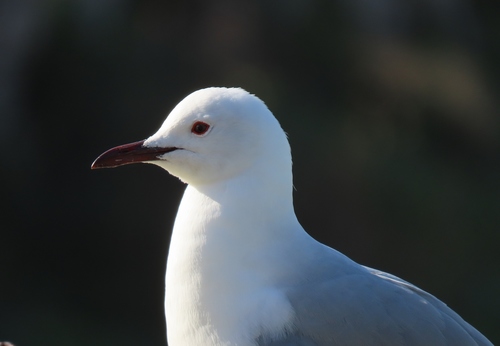
Hartlaub's Gull
Chroicocephalus hartlaubii
Hartlaub's Gull is the charismatic 'city gull' of Southern Africa, known for its dainty features and bold personality. A frequent visitor to coastal backyards, this clever bird is a master of urban adaptation.
Quick Identification
Size
Length: 36–38 cm (14–15 in); Wingspan: 82–94 cm (32–37 in); Weight: 235–340 g (8.3–12 oz)
Colors
White head and underparts with pale grey wings and mantle; wingtips are black with white spots; legs and bill are deep, dark red.
Key Features
- Small, slender build with a dainty dark red bill
- Pure white head year-round without a dark hood
- Deep red legs that can appear black from a distance
- Small white 'mirrors' on the black wingtips
When You’ll See Them
Geographic range
Where Does the Hartlaub's Gull Live?
This species is a coastal specialist native to the southwestern shores of Africa. Its range is primarily concentrated along the Atlantic coastline of South Africa and Namibia, spanning from the Swakopmund region in the north down to the Agulhas Bank in the south. While it is rarely found far from the ocean, it has successfully expanded into urban inland areas within a few kilometers of the coast, particularly around major cities like Cape Town.
Basemap © OpenStreetMap contributors
Behavior
Hartlaub's Gulls are highly social and remarkably bold birds that have adapted exceptionally well to human environments. Unlike many of their more cautious coastal relatives, these gulls are a common sight in urban centers, suburban gardens, and busy parks, particularly throughout the Western Cape. They are gregarious by nature, often found in large, noisy groups whether they are roosting on rooftops or foraging for food on a school playing field.
These gulls exhibit a high level of opportunistic intelligence. They are known to follow humans in hopes of a snack and can be quite assertive around outdoor cafes. Despite their urban success, they maintain their natural colonial instincts, often nesting in large groups on offshore islands or, increasingly, on the flat roofs of city buildings. Their social structure is complex, involving various vocal calls and physical displays used to defend small temporary feeding territories or to communicate with mates.
EverydayEarth exclusive
Camera Tips
To capture high-quality footage of Hartlaub's Gulls, focus your camera on flat, elevated surfaces or near shallow water sources. In a suburban backyard, a wide birdbath is the ultimate attractant. These gulls are enthusiastic bathers and will often spend several minutes splashing and preening, providing excellent dynamic video opportunities. Position your AI camera at a height of 2 to 4 feet, roughly level with the birdbath or a garden wall, to get a clear eye-level view of their distinctive dark red bills and pale grey plumage.
Lighting is a critical factor when filming white birds like Hartlaub's Gull. To avoid 'blowing out' the highlights (where the white feathers lose all detail in the sun), try to position your camera so the sun is behind it or use the early morning and late afternoon light. These 'golden hours' not only provide softer light but also coincide with the birds' peak activity periods as they move between roosting and feeding sites. Setting your camera to a higher shutter speed or a 60fps video mode will help capture the rapid wing movements and water splashes during bathing without motion blur.
If you are setting up a camera in a more natural or open area, look for 'loafing' spots—flat rocks or jetties where the gulls gather to rest. These birds are creatures of habit and will return to the same spots daily. Avoid using food as bait, as this can lead to aggressive 'scrambles' that result in poor-quality, chaotic footage. Instead, focus on natural behaviors like preening or social interaction. For the best AI detection results, ensure the background is relatively dark or high-contrast (like green foliage or dark stone) so the bird's white silhouette stands out clearly to the sensor.
Similar Species
Species that look similar or are commonly confused with Hartlaub's Gull.
Frequently Asked Questions
Record Hartlaub's Gull at your habitat
Connect a camera to start building your own species record — AI identifies every visitor automatically.