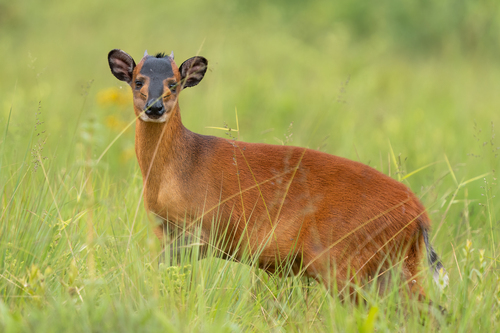
Harvey's Duiker
Cephalophorus harveyi
A flash of chestnut in the forest shadows, Harvey's Duiker is a master of the African undergrowth. This elegant, small antelope is one of the most rewarding sightings for any forest camera trap.
Quick Identification
Size
Length: 85–95 cm (33–37 in); Shoulder height: 40 cm (16 in); Weight: 9–15 kg (20–33 lbs)
Colors
Rich reddish-chestnut body with a distinct dark brown or black blaze on the bridge of the nose; legs are typically darker or blackish towards the hooves.
Key Features
- Bold black facial blaze from nose to forehead
- Vibrant reddish-brown coat
- Short, spiked horns present in both sexes (6-9 cm)
- Small, rounded back profile
When You’ll See Them
Geographic range
Where Does the Harvey's Duiker Live?
Native to the vibrant ecosystems of East Africa, Harvey's Duiker is primarily found in Kenya and Tanzania. Its range extends into the forested highlands of southern Ethiopia, parts of Somalia, and southward into Malawi. These antelopes are specialists of the dense canopy, thriving in locations ranging from coastal scrub forests to the high-altitude slopes of Mount Kilimanjaro and Mount Kenya.
Basemap © OpenStreetMap contributors
Behavior
The name 'duiker' comes from the Afrikaans word for 'diver,' referring to their habit of diving into thick cover when startled. They are very alert and use a high-pitched whistle as an alarm call. In the wild, they are known to follow arboreal monkeys, such as colobus or guenons, waiting on the forest floor to scavenge fruit and seeds dropped from the canopy above.
Interactions with humans are rare due to their elusive nature and preference for thick cover. However, they are sensitive to habitat fragmentation and are often hunted for bushmeat, which makes them even more wary of human presence in inhabited areas.
EverydayEarth exclusive
Camera Tips
Capturing Harvey's Duiker on camera requires a low-profile setup. Because these are small antelopes, mount your camera approximately 30 to 50 centimeters (12 to 20 inches) off the ground. If the camera is too high, you will only see their backs; a lower angle captures the crucial black facial blaze and leg markings needed for a positive identification. Angle the camera slightly upward if placing it on a slope.
Target 'micro-habitats' where they are likely to linger. Look for large fruiting trees, particularly wild figs or various species of Ficus, as these act as natural magnets for duikers. Another excellent spot is near a 'midden'—a specific area where the duiker regularly defecates to mark its territory. Duikers are creatures of habit and will return to these spots daily, providing a consistent opportunity for high-quality captures.
Use a camera with a very fast trigger speed and a quiet shutter. Harvey's Duikers are incredibly skittish; the click of a traditional mechanical shutter or the glow of a low-quality infrared flash can send them bolting. No-glow (Black LED) infrared flash is highly recommended to avoid spooking the animal during the early morning or late evening hours when they are most active. If your camera supports it, high-definition video is better than photos, as it allows you to observe their unique scent-marking behavior.
Avoid frequent visits to the camera site. Duikers have a very keen sense of smell and will avoid an area if it reeks of human scent. Set your camera and leave it for at least two weeks. If you must use a lure, small piles of fallen fruit common to the local area can work, but the best 'lure' is simply placing the camera in an undisturbed, well-covered game trail.
Similar Species
Species that look similar or are commonly confused with Harvey's Duiker.
Frequently Asked Questions
Record Harvey's Duiker at your habitat
Connect a camera to start building your own species record — AI identifies every visitor automatically.