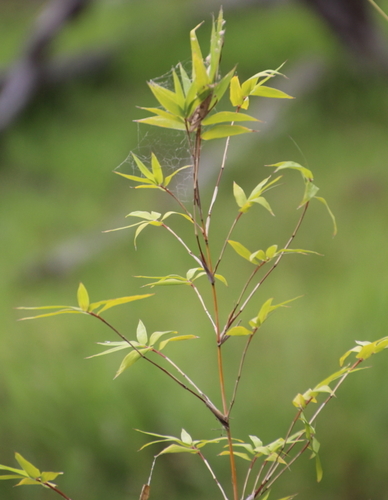
hedge bamboo
Bambusa multiplex
A lush, non-invasive clumping bamboo that transforms backyards into private sanctuaries. Its dense, feathery foliage is a favorite nesting site for songbirds and a stunning subject for time-lapse growth photography.
Quick Identification
Size
Height of 10-25 feet (3-8 meters); culm diameter of 0.5-1.5 inches (1.3-3.8 cm)
Colors
Bright green to golden-yellow culms; vibrant deep green feathery foliage
Key Features
- Clumping non-invasive growth habit
- Slender, hollow woody culms
- Dense, fern-like leaf arrangements
- No thorns or structural spines
When You’ll See Them
Behavior
Hedge bamboo is a perennial clumping bamboo, which means it grows in organized, tight clusters rather than spreading aggressively via underground runners. This makes it a well-behaved guest in suburban landscapes where it is frequently used to create living privacy screens. It is a highly responsive plant; its culms are incredibly flexible, allowing the plant to bend nearly double in high winds without snapping, only to spring back once the weather calms.
Environmentally, hedge bamboo acts as a cornerstone for backyard ecosystems. Its dense, interlocking branches and thick canopy of leaves provide a protected microclimate that stays cooler in the summer and shielded from wind in the winter. While it doesn't 'behave' in the animal sense, it shows distinct growth spurts during the rainy season, where new shoots can emerge and reach their full height in a matter of weeks, a process that is fascinating to watch on a day-to-day basis.
EverydayEarth exclusive
Camera Tips
Hedge bamboo is a fantastic subject for time-lapse photography because of its legendary growth speed. During the peak spring or summer growing season, identify a new shoot (called a 'culm') as it first breaks through the soil. Mount your camera on a sturdy tripod or fence post about 5 feet away, angled slightly upward. Set your AI camera to take a still image every hour. Within just 14 days, you will have a spectacular video showing the bamboo 'telescoping' upward, sometimes growing several inches in a single 24-hour period.
If you are interested in capturing the wildlife that uses the bamboo as a home, placement is key. Because the foliage is so dense, the interior of a bamboo hedge is often too dark for standard camera sensors. Instead, position your camera at the edge of the bamboo where it meets an open space or a bird feeder. This 'edge habitat' is where birds like cardinals, wrens, and finches will pause before darting into the safety of the bamboo stalks. Setting your camera at a height of 5 feet will usually align with the most active 'perching' zone of the plant.
One challenge with bamboo is the constant movement of its leaves, which can lead to thousands of false motion triggers on sensitive cameras. To optimize your settings, use your camera’s 'Activity Zone' feature to exclude the topmost branches that sway the most in the wind. Focus your detection zone on the lower, thicker culms or a specific gap in the foliage where animals are likely to pass through. If your camera has AI 'Animal Detection,' ensure it is enabled so the system ignores the rhythmic swaying of the stalks.
For the best visual results, pay attention to the light. Bamboo leaves are slightly translucent; if you position your camera so it is facing toward the morning sun (with the bamboo between the sun and the lens), the leaves will glow with a brilliant lime-green light. This backlighting creates high-contrast images that make it much easier for AI software to identify birds or squirrels moving through the branches. In winter, the evergreen nature of hedge bamboo makes it a perfect green backdrop for capturing wildlife against an otherwise brown or snowy landscape.
Frequently Asked Questions
Record hedge bamboo at your habitat
Connect a camera to start building your own species record — AI identifies every visitor automatically.