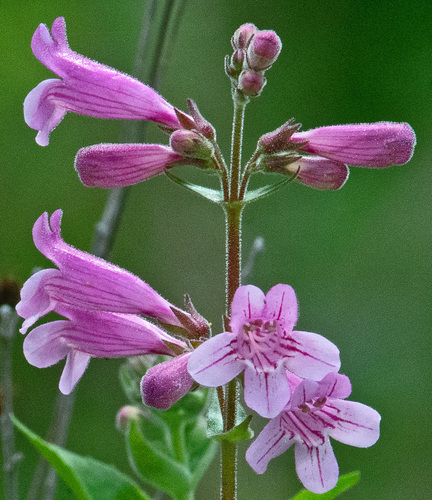
Heller's Beardtongue
Penstemon triflorus
A magenta masterpiece of the Texas Hill Country, Heller's Beardtongue brings a splash of royal purple to rocky landscapes. This drought-tolerant native is a magnet for hummingbirds and a true icon of the Edwards Plateau.
Quick Identification
Size
Stands 30–60 cm (12–24 inches) tall; individual flowers are approximately 2.5–3 cm (1 inch) long.
Colors
Brilliant magenta to deep purple-violet blossoms, often with white throats and dark purple nectar guides.
Key Features
- Clusters of three showy, tubular flowers per node
- Vivid magenta to deep purple petals with interior nectar lines
- Prominent hairy sterile stamen (the 'beardtongue')
- Dark green, lance-shaped leaves with slightly serrated edges
When You’ll See Them
Geographic range
Where Does the Heller's Beardtongue Live?
Heller's Beardtongue is a proud North American native with a very specific home: it is endemic to the Edwards Plateau region of Central Texas. This 'Texas original' is primarily found clinging to the limestone outcroppings of the Hill Country, rarely venturing far beyond this rugged geographic heart of the Lone Star State. While its natural range is restricted to a small cluster of Texas counties, its beauty has made it a favorite in drought-tolerant xeriscapes throughout the American Southwest.
Basemap © OpenStreetMap contributors
Behavior
Heller's Beardtongue is a perennial wildflower that is as hardy as it is beautiful. It spends the cooler months as a low-profile rosette of green leaves, staying close to the ground to conserve energy. As the Texas spring arrives, it sends up elegant, slender stalks that support its signature trios of purple blossoms. This species is a vital component of its local ecosystem, acting as a primary nectar source for early-season pollinators.
While it may appear delicate, this plant is a 'lithophyte' at heart, often found growing directly out of rocky limestone crevices where other plants would struggle to find a foothold. It does not spread aggressively, instead forming tidy, attractive clumps that return year after year. Its primary 'interaction' with the world is through its specialized floral shape, which is perfectly evolved to accommodate the heads of bumblebees and the long bills of hummingbirds.
EverydayEarth exclusive
Camera Tips
Capturing the vibrant beauty of Heller's Beardtongue is all about highlighting its visitors. Since this plant is a favorite of the Black-chinned Hummingbird and various native bees, set your camera on a tripod at a low height—roughly 18 to 24 inches off the ground. Angle the lens slightly upward to capture the interior of the tubular flowers, where the 'beardtongue' and nectar guides are most visible. This perspective also makes for a more dramatic shot when a pollinator enters the frame.
Because the Edwards Plateau can be quite windy, use a camera with a fast trigger speed to avoid motion blur from the flower stalks swaying. If your AI camera has a 'pet' or 'small animal' mode, it may help in detecting the rapid movement of hummingbirds. For the best color saturation, ensure your camera is positioned to take advantage of the morning sun; the magenta hues of the petals can 'wash out' or look overexposed in the harsh midday Texas heat. A 45-degree side angle to the sun often provides the best depth and detail.
Since the blooming window is relatively short (mid-spring), placement is everything. Look for the tallest spikes with the most unopened buds to ensure your camera stays relevant for the full two-to-three-week blooming period. If your backyard setup allows, place the camera 3 to 5 feet away from the plant to give the AI enough room to frame the entire stalk while still being close enough to identify the insects and birds that land on it. No bait is required for this species; the nectar itself is the ultimate lure!
Similar Species
Species that look similar or are commonly confused with Heller's Beardtongue.
Frequently Asked Questions
Record Heller's Beardtongue at your habitat
Connect a camera to start building your own species record — AI identifies every visitor automatically.