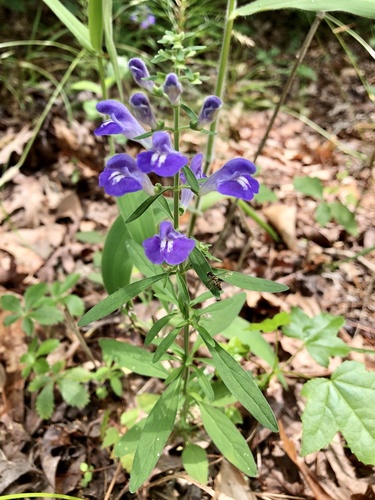
Helmet skullcap
Scutellaria integrifolia
A delicate architectural marvel of the eastern meadows, the Helmet skullcap is named for the tiny, cap-like structure that sits atop its violet blooms. This native perennial is a favorite of bumblebees and a stunning indicator of healthy, sun-drenched acidic soils.
Quick Identification
Size
12 to 24 inches (30 to 60 cm) in height
Colors
Pale blue to deep violet flowers, often with white or spotted throats; stems and leaves are a dull medium green
Key Features
- Distinctive 'helmet' or 'skullcap' shape on the upper petal
- Square stems characteristic of the mint family
- Opposite, narrow leaves with smooth edges (integrifolia means 'entire-leaved')
- Fine, downy hairs covering the stem and foliage
When You’ll See Them
Behavior
The Helmet skullcap is a perennial wildflower that brings a touch of elegance to the early summer landscape. Unlike many members of the mint family, it does not spread aggressively through underground runners; instead, it grows in polite, upright clumps. It relies heavily on native long-tongued bees for pollination, which must be strong enough to push past the flower's lower lip to reach the nectar tucked inside the tube.
This species is highly adapted to fire-prone or disturbed environments. In the wild, it often thrives in the years following a controlled burn or a clearing, as it requires high light levels and struggles when shaded out by dense brush. While it is hardy, it is sensitive to soil pH, strictly preferring the acidic conditions found in sandy pinelands and coastal meadows.
EverydayEarth exclusive
Camera Tips
Capturing the Helmet skullcap requires a different approach than fast-moving wildlife. Because these flowers are relatively low to the ground, you should set your camera on a low-profile tripod or a ground mount just 10-15 inches off the forest floor. To get that professional 'blurred background' look (bokeh) that makes the blue petals pop, use a wide aperture setting or 'Macro' mode if your camera supports it. Position the lens about 2-3 feet away from the best-looking bloom cluster to ensure the fine hairs on the stem are in sharp focus.
Lighting is your best friend with this species. Avoid the harsh midday sun, which can wash out the delicate violet hues. Instead, aim for the 'Golden Hour'—just after sunrise or before sunset—when the soft, angled light highlights the velvety texture of the petals. If you are shooting on a bright day, a simple piece of white cardboard used as a reflector can help bounce light into the shadowy 'throat' of the flower, revealing the intricate white markings inside.
For a truly dynamic backyard camera project, set your device to time-lapse mode during a clear morning in June. Set the interval to one photo every 60 seconds. This will allow you to capture the flowers opening as the sun hits them and the frequent visits from bumblebees and leafcutter bees. Ensure your camera is secured firmly, as even a slight breeze can cause 'motion blur' on a plant this slender; using a fast shutter speed (1/200th or higher) will help freeze the plant in place if there is a light wind.
Frequently Asked Questions
Record Helmet skullcap at your habitat
Connect a camera to start building your own species record — AI identifies every visitor automatically.