Hercules' club
Zanthoxylum clava-herculis
With its prehistoric-looking spiked trunk and citrus-scented leaves, the Hercules' club is a striking pillar of the Southern coastal landscape. Often called the 'Toothache Tree,' it offers both a unique visual profile and a vital sanctuary for the magnificent Giant Swallowtail butterfly.
Quick Identification
Size
A small tree or large shrub reaching 6–10 metres (20–30 feet) in height with a trunk diameter of up to 30 centimetres (12 inches).
Colors
Light gray bark with prominent tan or brown corky bumps; glossy dark green foliage that may turn yellowish in autumn.
Key Features
- Distinctive cone-shaped corky spines on the trunk and branches
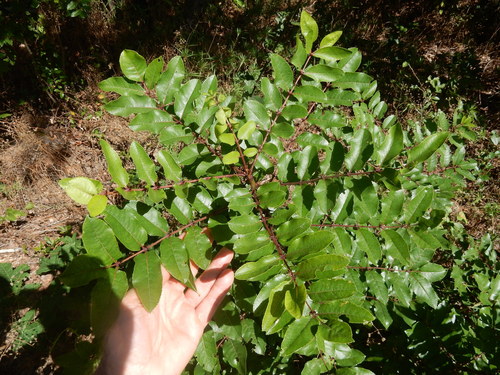
- Pinnately compound leaves with 7-19 serrated leaflets
- Small clusters of greenish-white flowers at the branch tips
- Aromatic leaves that smell like lime or citrus when crushed
When You’ll See Them
Geographic range
Where Does the Hercules' club Live?
Native to the North American continent, the Hercules' club is a signature species of the Southeastern United States. Its core range stretches along the coastal plains from southern Virginia down through the Florida peninsula, extending westward across the Gulf States into East Texas and north into Oklahoma. You will most often find it flourishing in the sandy soils of maritime forests and along the sun-drenched edges of woodland clearings.
Basemap © OpenStreetMap contributors
Behavior
Hercules' club is a fascinating 'pioneer' species, often being one of the first trees to colonize disturbed sites or forest edges. It is famous for its chemical properties; the bark and leaves contain a numbing alkaloid called herculin. When chewed, these parts cause a tingling, numbing sensation in the mouth, earning it the nickname 'Toothache Tree.' While it may appear menacing with its spiked trunk, it is a peaceful member of the ecosystem that provides essential structure for coastal habitats.
Ecologically, this tree is a vital host for the Giant Swallowtail butterfly. Female butterflies seek out the aromatic leaves to lay their eggs, and the resulting 'bird poop' camouflaged caterpillars feed exclusively on the foliage. Humans have historically used the tree not just for dental relief, but also for its unique aesthetic in xeriscaping and native plant gardens, where its prehistoric appearance serves as a conversation starter.
EverydayEarth exclusive
Camera Tips
To capture the true essence of the Hercules' club, position your camera to highlight its most dramatic feature: the spiked bark. Set your camera at chest height (about 4-5 feet) and approximately 2-3 feet from the trunk to get a detailed macro-style view of the corky, cone-shaped spines. Using a side-angle during the early morning or late afternoon ('Golden Hour') will create long shadows that emphasize the 3D texture of the bark, making the 'clubs' pop in your footage.
If your goal is to document wildlife activity, focus your camera on the foliage during the spring and summer months. This tree is a magnet for the Giant Swallowtail, North America's largest butterfly. Mount your camera slightly above the mid-level branches where the leaves are most lush. Use a high-speed trigger or 'burst mode' to capture the fast-moving butterflies as they hover to lay eggs or the caterpillars, which look remarkably like bird droppings, as they move along the stems.
During the spring (typically March to May), the tree produces clusters of greenish-white flowers. These are relatively small, so setting your camera to a higher resolution (4K if available) is recommended to see the various pollinators—including bees and small wasps—that visit the blooms. Because the tree is deciduous in the northern parts of its range but can be semi-evergreen in the south, winter is a great time to strip away the visual 'noise' of the leaves and focus purely on the architectural silhouette of the spiny branches against a clear blue sky.
No bait is needed for the tree itself, but planting nectar-rich flowers like lantana or milkweed nearby can draw more butterflies toward your camera's field of view. Ensure your camera is secured firmly, as the tree's own spines can occasionally snag equipment if it is placed too loosely or moves in the wind.
Similar Species
Species that look similar or are commonly confused with Hercules' club.
Frequently Asked Questions
Record Hercules' club at your habitat
Connect a camera to start building your own species record — AI identifies every visitor automatically.