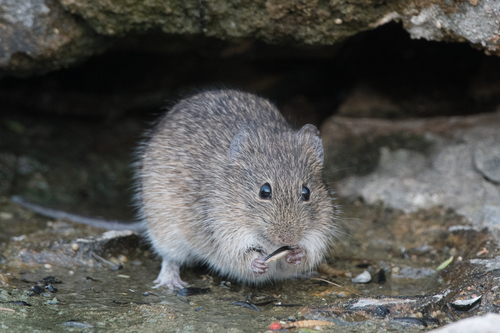
Hispid Cotton Rat
Sigmodon hispidus
The Hispid Cotton Rat is the 'architect' of the undergrowth, famous for weaving intricate grass tunnels. This bristly-haired resident is a vital link in the backyard ecosystem, active at all hours of the day.
Quick Identification
Size
Total length 202–340 mm (8.0–13.4 in); Weight 50–250 g (1.8–8.8 oz)
Colors
Grizzled 'salt and pepper' fur with a mix of black, brown, and buff; grayish-white or pale buff underbelly
Key Features
- Coarse, bristly (hispid) fur texture
- Short, hairy tail usually less than half the total body length
- Small, rounded ears nearly hidden in thick fur
- Large, dark eyes and a blunt muzzle
When You’ll See Them
Geographic range
Where Does the Hispid Cotton Rat Live?
Native to North America, the Hispid Cotton Rat is found across a wide expanse of the southern and central United States. Its territory stretches from the Atlantic coast of Virginia down to Florida, reaching as far north as the Platte River in Nebraska and extending westward to the arid landscapes of Arizona. While it was once thought to inhabit much of Central America, recent DNA studies have focused its primary range within the U.S. and northern Mexico.
Basemap © OpenStreetMap contributors
Behavior
The Hispid Cotton Rat is a restless and energetic rodent known for its unique 'runway' systems. These rats create a network of well-maintained paths through dense grass by clipping vegetation right down to the soil. These trails allow them to zip between feeding areas and burrows with incredible speed, staying hidden from the sharp eyes of hawks and owls. Unlike many other small mammals that are strictly nocturnal, cotton rats are polyphasic, meaning they are active in short bursts throughout both the day and night.
In social terms, they are generally solitary and can be surprisingly aggressive toward intruders. They are excellent swimmers and capable climbers, though they prefer to spend the vast majority of their time on the ground. Their high reproductive rate makes them a 'boom or bust' species; in years with high rainfall and thick grass, their populations can explode, providing a critical food source for a wide variety of North American predators.
EverydayEarth exclusive
Camera Tips
To successfully capture a Hispid Cotton Rat on your backyard camera, you must focus on their highway system. Look for 2-inch wide 'tunnels' or runways in tall, un-mown grass. Place your camera very low to the ground—no more than 3 to 5 inches high—and angle it directly down the length of the runway. Because these rats are low-slung and move quickly, a high-mounted camera will often only capture a blurry brown streak or miss them entirely.
Baiting is an excellent way to get them to pause for a high-quality photo. A small pile of birdseed, cracked corn, or sliced apples placed near the entrance of a burrow or along a visible runway works wonders. Since they are active during the day, you don't have to rely solely on infrared night vision; try to position the camera so the runway is well-lit by the morning sun for the best color detail of their unique grizzled fur.
Settings are crucial for these fast-moving rodents. Use a 'Burst' or 'Multi-shot' mode with at least 3 photos per trigger, as they often dart in and out of cover. If your camera has a sensitivity setting, turn it to 'High' to ensure the heat signature of a small rodent triggers the sensor. In suburban yards, place cameras near woodpiles, compost heaps, or along the edges of fences where tall grass is allowed to grow, as these are the preferred transit corridors for the species.
Frequently Asked Questions
Record Hispid Cotton Rat at your habitat
Connect a camera to start building your own species record — AI identifies every visitor automatically.