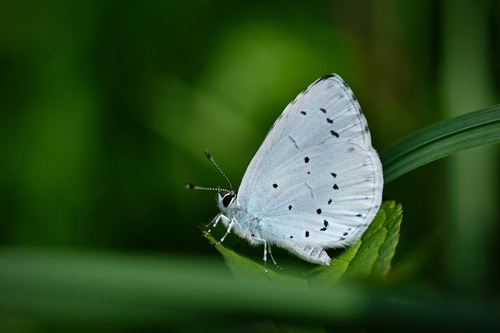
Holly Blue
Celastrina argiolus
The Holly Blue is a shimmering sky-blue visitor that brings life to garden hedges in early spring and late summer. Unlike other blues that stay low to the grass, this arboreal butterfly is a master of the treetops and shrubbery.
Quick Identification
Size
Wingspan of 26–34 mm (1.0–1.3 inches)
Colors
Bright sky-blue upper wings. Males have narrow black borders; females have wide black borders on the forewings. The underside is a pale, silvery-blue with small black spots.
Key Features
- Pale silvery-blue underside with tiny black spots and no orange markings
- Bright sky-blue upper wings
- High-flying habit around trees and tall shrubs
- Wingspan of roughly 1 inch
When You’ll See Them
Behavior
The Holly Blue is a distinctive and mobile butterfly, frequently seen fluttering at head height around shrubs and trees rather than staying low to the ground like many other 'blue' species. It is famous for its 'cyclical' life cycle, which utilizes different host plants for its two annual generations. In the spring, the butterflies are mostly found around Holly, where they lay their eggs on flower buds; in the summer, the second generation shifts its focus to Ivy.
Unlike the more habitat-specific blues that require specialized grasslands, the Holly Blue is a true garden generalist. It is highly adaptable and can be found in urban centers as easily as in the countryside. Because it flies higher than its cousins, it is often seen patrolling the tops of hedges or dancing around the canopy of garden trees on warm, sunny days. It is a solitary flyer, though several may gather in a particularly nectar-rich garden.
EverydayEarth exclusive
Camera Tips
To capture the Holly Blue on an AI-powered backyard camera, placement is everything. Since these butterflies are 'high flyers,' don't place your camera at ground level. Instead, mount your camera between 4 and 6 feet high, facing a south-facing hedge or a large stand of Ivy or Holly. These are the primary corridors where the Holly Blue patrols. If you have a flowering shrub like Buddleia or a patch of Forget-me-nots, aim your camera there during the peak spring and summer months.
Because butterflies are small and fast, you need to optimize your camera's trigger settings. Set your AI camera to its highest sensitivity and, if possible, use a 'burst' mode that takes 3-5 photos per trigger. The Holly Blue is known for its erratic, dancing flight pattern, so capturing multiple frames increases your chance of getting a clear shot of the wings fully open. Ensure the camera has a clear line of sight with no moving leaves in the foreground that might cause false triggers.
Lighting is your best friend when photographing blues. This species is most active in full sun, and the iridescent blue of their wings pops beautifully in natural light. Position your camera so the sun is behind it or to the side; direct midday sun can sometimes wash out the delicate silvery-blue of the underside. If your camera allows for focal adjustments, set it for a 'macro' or close-up range (around 1-3 feet) and place a nectar-rich 'lure' plant like a potted Lavender or Marjoram in that sweet spot.
Finally, consider the season. The first brood emerges in late April when many other butterflies are still dormant. This is the best time to catch them because there is less competition for the camera's attention. In late summer, focus your camera on flowering Ivy. This is often the only nectar source available, and Holly Blues will congregate there, providing excellent opportunities for high-quality footage before they disappear for the winter.
Similar Species
Species that look similar or are commonly confused with Holly Blue.
Frequently Asked Questions
Record Holly Blue at your habitat
Connect a camera to start building your own species record — AI identifies every visitor automatically.